
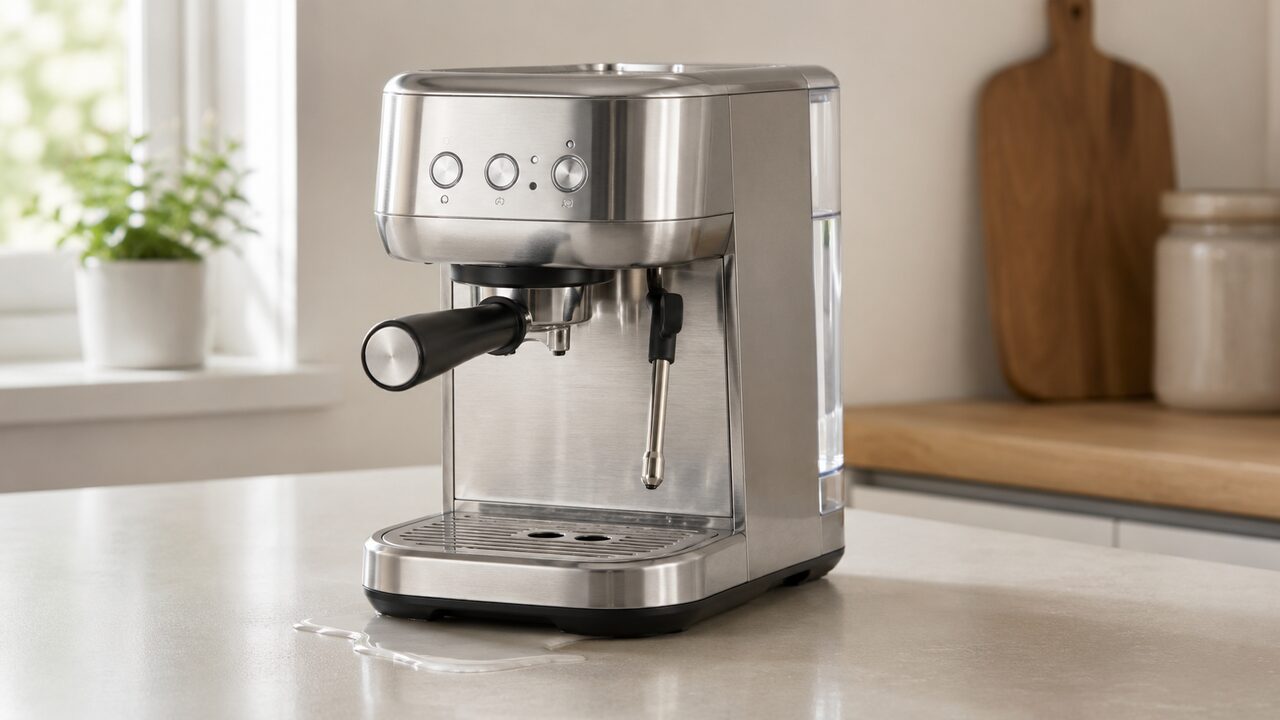
If your Breville Bambino Plus is leaking water, first identify where the water appears and when it starts. Water discharged into the drip tray immediately after steaming is normally the automatic purge. Water repeatedly reaching the counter, collecting beneath the machine, escaping around the portafilter or leaking from the tank needs a different check.
This guide is for the Breville Bambino Plus BES500 series, including the U.S. BES500BSS. It does not cover the original Bambino BES450, which has different controls and steam behavior.
Unplug the machine immediately if water emerges from the housing, reaches the cord, plug or outlet, trips a breaker or GFCI, or appears with a burning smell, crackling sound or unusual heat. Do not power it again to locate an internal leak.
Bambino Plus leak diagnosis at a glance
| Where or when water appears | Most likely first branch | First safe check |
|---|---|---|
| Inside the drip tray after steaming | Normal automatic purge | Keep the tray seated and empty it when the indicator rises |
| Under the drip tray after a shot or purge | Tray not fully seated, tray overflow, splash or misdirected purge water | Empty, clean, dry and firmly reinstall the complete tray |
| At the rear while the machine is off | Tank seating, tank body or outlet-valve leak | Remove the tank, dry both surfaces and test the tank separately |
| Around the portafilter during extraction | Incorrect lock-in, grounds on the rim or excessive dose | Stop the shot, release pressure, clean the rim and check the dose |
| From the steam tip or wand joint | Residual water, blocked tip, loose tip seal or steam-system fault | Let the wand cool and identify whether the water comes from the tip or joint |
| From the base or housing | Internal hose, valve, fitting or other internal fault | Switch off, unplug and arrange service |
| Only during cleaning or descaling | High waste-water volume, container placement or tray overflow | Stop safely, let the machine cool and verify the documented setup |
Do not diagnose from the final puddle alone. Water can travel along the tray, base or countertop before becoming visible. The first wet point and the operating moment are more useful than the largest wet area.
Confirm the exact machine before testing
Check the label on the base only while the machine is unplugged, cool and dry. A Bambino Plus has separate 1 CUP, 2 CUP and STEAM buttons, MILK TEMP and MILK FOAM controls, an automatic steam wand and a milk-temperature sensor built into the drip-tray area. The model family should read BES500; color and regional suffixes can vary.
Do not assume that instructions for another 54 mm Breville or Sage machine apply. Similar portafilter diameters do not prove that the tank connection, purge path, tray, seals or internal layout are the same.
Run one controlled dry-and-observe test
This test separates a tank leak that occurs while idle from water released during brewing or steaming. Do it only if the machine has not leaked into an electrical area.
- Switch off and unplug. Let the group head and steam wand cool. Remove cups, the portafilter and the milk jug.
- Dry the outside completely. Empty and dry the drip tray and grid, wipe the counter, dry the tank exterior and blot accessible recesses without inserting cloths or tools into the housing.
- Check the tank while the machine remains off. Fill below MAX, dry it again, reinstall it flush against the rear and wait several minutes. Water appearing before power-on points toward the tank, its removable connection or a machine-side inlet that needs support.
- Install the complete drip tray firmly. The plastic tray and stainless grid must sit correctly, with the tray pushed fully into the machine.
- Test one blank shot. Plug in only after the counter and machine exterior are dry. Place a cup under the empty group head, press 1 CUP once and observe from outside. Do not reach beneath the powered machine.
- Test one short steam purge only if the blank shot stays dry. Direct the lowered wand over the tray, start and stop steam briefly, then watch where the automatic purge water goes.
Stop after the first repeatable result. Repeated shots and steam cycles can enlarge a puddle without telling you which component failed. For multi-outlet water loss rather than leakage, use the Bambino Plus water-flow troubleshooting guide.
Water in the drip tray after steaming is usually normal
The Bambino Plus automatically purges after steam. When the wand is returned to its lowered position, the machine releases water into the drip tray to prepare the heating system for espresso again. A pumping sound during extraction or steaming is also documented as normal.
This is expected only when the water reaches the tray. The current U.S. BES500 instruction manual tells owners to keep the tray firmly pushed into place and empty it whenever the full indicator is displayed. Its care instructions also say to remove, empty and clean the tray after each use or when that indicator rises.
- Normal: purge water enters the tray, remains contained and stops after the purge.
- Needs correction: the tray is full, tilted, partly inserted or assembled incorrectly.
- Needs service: water bypasses a correctly fitted empty tray and repeatedly emerges from the base or housing.
Do not block the purge outlet, add adhesive seals to the machine or modify the tray to redirect water. An improvised barrier can hide the first wet point, obstruct drainage or move water toward the housing.
Water underneath the drip tray or machine
A small puddle under the tray can come from four different paths: an overfilled tray, water splashed while rinsing the group head or portafilter, automatic purge water missing the tray, or an internal leak reaching the base. Drying everything first is the only reliable way to separate them.
Check the removable tray first
- Remove the tray only after switching off and allowing hot parts to cool.
- Empty it even if the indicator has not risen fully.
- Wash the tray and grid in warm soapy water, rinse and dry them; do not put them in a dishwasher.
- Inspect the removable plastic tray for a visible crack, distortion or damaged edge.
- Reassemble the grid correctly and push the tray fully home.
Place the machine on a stable, level, dry and water-resistant counter as the manual requires. Do not tilt or lift a powered machine to watch underneath. If the tray is intact and correctly seated but water again comes from behind it or from the base, unplug the machine and treat the path as internal.
Rule out water added from outside
Rinsing a portafilter under the group head without a cup can splash the rear wall and tray edges. Steam-wand purging can also move droplets already sitting on the grid. Use a cup for the single blank-shot test and begin with a completely dry tray area. If the counter remains dry, the earlier puddle was probably splash or overflow rather than a machine-side leak.
Water leaking from the rear or tank
A rear puddle that develops while the machine is off deserves a tank-only check before any powered test. Remove the tank, keep it upright, wipe it dry and place it on a dry towel or tray for several minutes. Look for water at the tank body, seam and outlet area without dismantling the valve.
| Observation | Meaning | Next action |
|---|---|---|
| Tank leaks while separate from the machine | Tank body, seam or outlet assembly is damaged | Stop using that tank and identify the exact BES500 replacement |
| Tank stays dry separately but leaks when loosely installed | Incorrect seating or incomplete connection is likely | Reinstall it flush against the rear without forcing it |
| Tank is correctly seated but water returns at the machine-side inlet | The receiving seal or internal inlet may need service | Unplug and contact Breville |
| No leak while idle; water appears only during operation | The tank itself is less likely to be the source | Continue by testing the tray, group head or internal stop condition |
The 1 CUP, 2 CUP and STEAM buttons illuminate when the BES500 detects sufficient water and a correctly attached tank, but illuminated buttons do not prove that every tank seal is watertight. If the removable tank or tray is visibly damaged, use the BES500 replacement-parts guide to verify the exact regional model and part number before ordering.
Espresso leaking around the portafilter
Water or espresso escaping over the portafilter rim during a shot is different from a leak beneath the machine. The manual identifies three first causes: the portafilter is not inserted correctly, coffee grounds remain on the basket rim, or the basket contains too much coffee.
- Stop extraction and wait until flow and pressure have ended before touching the portafilter.
- Remove the portafilter carefully. Clean coffee from the basket rim and the accessible underside of the group head with the machine cool.
- Check the basket dose. The current manual lists 8–11 g for the 1 CUP basket and 16–19 g for the 2 CUP basket.
- Make sure the basket is seated flat inside the correct 54 mm portafilter.
- Insert the portafilter at the marked position and rotate it toward the center until resistance is felt. Do not force it beyond normal resistance.
- Test once with a clean, suitable dose. Stop if liquid still sprays sideways or the handle will not lock normally.
If dose, rim cleanliness and lock-in solve the leak, the machine does not need a new seal. For normal basket selection, dose and puck setup, use the complete Bambino Plus settings guide.
If a clean correctly dosed basket still leaks around the group head, or the portafilter suddenly locks much farther than before, the sealing or locking interface needs inspection. The BES500 manual does not provide a routine owner procedure for replacing the group seal or dismantling the shower assembly. Contact Breville or a qualified repairer rather than removing group-head hardware based on instructions for another model.
Water dripping from the steam wand
A little residual water from the steam tip during a purge is not the same as a leak from the wand joint. Let the wand cool, wipe it dry and observe whether the next water appears from the tip holes, the threaded tip connection or higher on the wand.
- Tip holes during purge: expected when the purge is commanded and directed into the tray.
- Weak or uneven steam with water: the tip may be blocked or the steam function may need its model-specific checks.
- Water at the tip joint: switch off, cool fully and verify that the documented removable tip is correctly fitted; do not overtighten it.
- Water higher on the wand or from the housing: stop using the machine and arrange service.
For no steam, weak steam, automatic texturing failure or milk-temperature and foam warning lights, follow the Bambino Plus steam-wand diagnosis. Repeating its purge against a leak from the wand joint will not identify an internal valve fault.
Leaks during cleaning or descaling
Cleaning and descaling move more waste water than a normal shot. The documented setups use an emptied and correctly installed drip tray plus a 2 L / 68 fl oz container positioned under the portafilter and steam wand. A small tray can overflow quickly if either the container or tray is omitted.
If water is simply reaching the tray or container, complete the correct procedure. If it escapes from the housing, reaches the cord or appears beneath the machine despite the correct setup, stop when it is safe to do so, unplug after dispensing has ended and let the machine cool. Do not immediately restart the cycle to reproduce the leak.
Use the separate Bambino Plus cleaning-cycle instructions for the tablet and disc procedure, or the BES500 descaling guide for the mineral-removal and rinse stages. The two cycles use different alerts and button combinations.
What not to do when the Bambino Plus leaks
- Do not remove the housing, base or electrical covers.
- Do not tip, lift or reach beneath the machine while it is plugged in.
- Do not block a purge outlet or add adhesive foam, rubber, putty or tubing to redirect water.
- Do not keep operating a machine that leaks from its housing or electrical area.
- Do not order an internal pump, valve, hose, heater or control part from the visible puddle alone.
- Do not substitute BES450, Barista Express or generic 54 mm disassembly instructions.
A puddle cannot identify an internal component from outside. The same exit point can be reached by water from a hose, valve, fitting or tank connection. Opening a 120 V appliance also adds electrical, hot-water and pressurized-system hazards.
When to contact Breville or a repairer
- Water emerges from the base, rear housing, control panel or another case seam.
- Water reaches or may have reached the cord, plug, outlet or an extension lead.
- The machine trips a GFCI or breaker, smells burned or makes an electrical sound.
- A correctly seated intact tank leaks only at the machine-side inlet.
- A clean, correctly dosed and normally locked portafilter still sprays from the group-head interface.
- The leak returns after one controlled dry test or is getting worse.
Record the full BES500 suffix, serial number, purchase date, first wet location and whether the leak occurs while idle, brewing, steaming or purging. A short video taken from a safe distance can help support. Use Breville’s current Bambino Plus product and support hub for registration, warranty, parts and repair routes.
For symptoms that extend beyond leakage, return to the BES500 troubleshooting hub and choose the failed function. Do not turn a no-power, no-water or heating fault into a parts purchase without diagnosis.
Breville Bambino Plus leaking water FAQs
Why does the Bambino Plus put water in the drip tray after steaming?
The automatic purge releases water into the drip tray after steam so the heating system is ready for espresso again. This is normal when the tray contains the water. Empty and firmly reinstall the tray if the indicator rises or water escapes around it.
Why is there water underneath my Bambino Plus?
Begin with the removable parts: dry the counter, empty and correctly seat the drip tray, then dry and reseat the tank. Run one controlled blank-shot test only if no electrical area became wet. Water emerging again from the base or housing requires service.
Why does espresso leak around the portafilter?
The first checks are portafilter insertion, coffee on the basket rim and excessive dose. Clean the rim, use the correct basket and dose, and rotate the portafilter until normal resistance is felt. Persistent leakage with correct setup can indicate a sealing or locking-interface problem.
Can I keep using the machine if the leak is small?
Only expected purge water contained inside the drip tray is normal. Do not continue using the machine if water comes from the housing, appears near electrical parts or repeatedly reaches the counter from an unknown source.
Should I replace the group-head seal myself?
Not as the first response. The manual first directs owners to correct portafilter insertion, clean the basket rim and reduce an excessive dose. It does not give a routine BES500 group-seal replacement procedure. If the leak remains, obtain model-specific guidance from Breville or a qualified repairer.
Does descaling fix a water leak?
Descaling removes mineral buildup from the water system; it does not repair a cracked tank, tray, hose, seal or fitting. Run the descale cycle when due, but do not repeatedly add descaler to diagnose water escaping from the housing.
The safest Bambino Plus leak diagnosis starts with a dry machine and one observation at a time. Expected purge water belongs inside the drip tray. A rear leak while idle points first to the removable tank; espresso over the portafilter rim points first to insertion, cleanliness and dose; and water from the base or housing ends owner troubleshooting.