
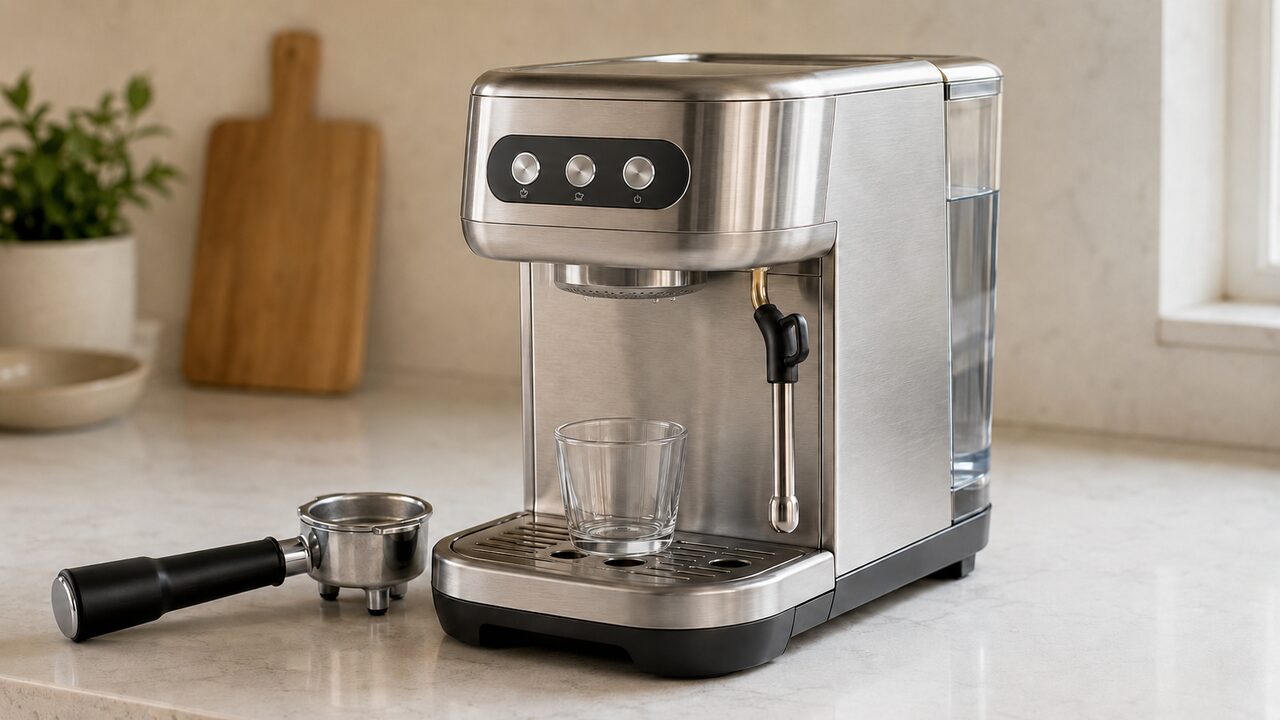
If your Breville Bambino Plus is not pumping water, remove the portafilter and test the empty group head first. Then test hot water through the steam wand. If neither path delivers water, fill the tank above MIN, press it down until it is fully seated and try one brief test again. If the empty group head flows normally but coffee will not pass through the portafilter, the pump is working; check the grind, dose, tamp and filter basket instead.
If your Breville Bambino Plus has no water coming out from the group head or hot-water wand, the same diagnosis applies: first determine whether the BES500 is failing to pull water from the tank, has air trapped in the circuit, or can move water through one outlet but not the other.
This guide is exclusively for the Breville Bambino Plus BES500 series, including the U.S. BES500BSS. It does not apply to the original Bambino BES450 or any Barista Express. For a different BES500 symptom, begin with the broader Bambino Plus troubleshooting guide.
Stop immediately if the machine smells hot or burnt, trips a breaker or GFCI, leaks from its housing, or repeatedly runs with a loud dry sound and no water. Switch it off, unplug it when safe and let it cool. Do not force water into the inlet, run the pump repeatedly or remove the case.
Identify where the water stops
“Not pumping water” can describe three different faults: no water from the machine at all, no water from the group head while the wand still works, or no espresso through a loaded portafilter even though the empty group head flows. The correct fix depends on which result you get.
| Test result | What it points to first | Next section |
|---|---|---|
| No water from the empty group head or hot-water function | Tank level or seating, loss of prime, scale, or an internal supply/pump fault | Start with the tank and one brief retest |
| Hot water works, but the empty group head does not | A restriction or fault in the brew path rather than total loss of water supply | Clean the accessible group-head area and check whether descaling is due |
| Empty group head flows, but a loaded portafilter does not | Grind, dose, tamp or basket resistance | Test the empty basket and coffee puck |
| Group head works, but hot water or steam does not | A wand-specific blockage, control or steam-path issue | Use the steam-wand troubleshooting guide |
| Both paths work, but a shot stops unusually early | Programmed shot volume rather than a dead pump | Check or reset the stored cup volume |
Run the empty group-head and hot-water test
Use fresh potable water and keep hands away from the outlets. The current U.S. BES500 instruction manual provides the exact hot-water controls used below.
- Fill and seat the tank. Bring the water above MIN without exceeding MAX. Refit the tank so it sits flush against the rear of the machine.
- Empty and reinstall the drip tray. This keeps normal purge water from being mistaken for a leak.
- Remove the portafilter. Place an empty heat-safe cup beneath the group head and keep the steam wand over the drip tray.
- Test the group head. With the machine in ready mode, press 1 CUP once. Normal water here proves that the machine can supply the brew path without resistance from coffee or a basket.
- Stop the test if necessary. Press 1 CUP again if you need to stop before the programmed volume finishes.
- Test hot water through the wand. Move the cup beneath the wand, lift the wand and press 1 CUP and MILK FOAM simultaneously. Hot water should start through the wand.
- Stop the hot water safely. Press 1 CUP once and wait for dripping to finish before moving the cup.
Do not confuse MILK FOAM with the MILK TEMP or STEAM button. Also do not put your hand under the wand to “feel” for flow: the water can be hot even when output looks weak.
If no water comes from either path
The BES500 manual lists an empty tank, a tank that is not fully inserted and a need for descaling as causes when water does not flow from the group head and there is no hot water. Check them in that order.
1. Correct the tank level and seating
- Remove the tank and fill it with fresh potable water above MIN.
- Check that no accessory, cable or debris is preventing the tank from sitting flat.
- Lower the tank straight into position and press it down completely.
- If you have just fitted a water filter, confirm that it was assembled and installed according to its instructions rather than left loose in the tank.
The manual recommends cold potable tap water and warns that highly filtered, demineralized or distilled water can affect how the machine is designed to function. Do not add coffee cleaner, descaler or another liquid merely to test the pump.
2. If the tank ran dry, make one controlled retest
A loud pump with no water can occur when the tank is empty or below MIN. After filling and firmly seating the tank, run one short empty-group-head test. If no water appears, try the documented hot-water control once. Stop if the pump remains loud and dry rather than repeating long cycles.
For a new machine that has never completed setup, use Breville’s first-use sequence: fill the tank to MAX, install the drip tray, place a 500 ml / 17 fl oz container under the portafilter area and wand, turn the machine on and press 1 CUP to run the first-use rinse and prime cycle. Do not repeatedly invoke “first use” on a previously working machine as an improvised reset.
3. Check whether descaling is due
Mineral buildup can reduce brewing flow, brewing temperature and machine performance. If the descale alert is active or flow declined gradually across both outlets, follow the complete Bambino Plus descaling procedure.
Do not start a chemical cycle if the machine cannot move any water at all. A descale cycle needs enough flow to circulate solution and then rinse it away. If zero flow prevents the documented cycle from starting or progressing, contact Breville instead of adding more solution or attempting to pressurize the tank manually.
If hot water works but the empty group head does not
This result shows that the tank can supply at least one water path. It does not prove every internal valve is healthy, but it moves the diagnosis away from a completely dry tank or totally inactive pump.
- Let the machine cool. Turn it off and unplug it before touching the group-head area.
- Wipe the accessible shower screen. Use a clean damp cloth to remove loose coffee particles. Do not unscrew the screen or insert metal objects into the machine.
- Retest without the portafilter. Reconnect the machine, enter ready mode and run one short 1 CUP flow into a heat-safe cup.
- Use the correct maintenance owner. Run the tablet cleaning cycle only when its 1 CUP and 2 CUP alert is due; descale only when the separate descale condition applies.
The Bambino Plus cleaning cycle and descaling are not interchangeable. If hot water remains available but the empty group head still delivers nothing after the safe external check, an internal brew-path valve or restriction requires professional diagnosis.
If the group head flows but no espresso comes through
Normal water from the empty group head means the machine is pumping. If the cup stays dry only after you lock in coffee, diagnose the resistance created by the basket and puck before blaming the pump.
Test an empty basket
- Remove the spent coffee and let the portafilter cool.
- Rinse the filter basket and hold it toward a light to check that its outlet holes are open.
- If a hole is blocked, use the pin on the supplied cleaning tool gently. Do not enlarge the holes.
- Lock the clean empty basket and portafilter into the group head and run a short water cycle.
If water passes through the empty basket, the basket and machine can flow without a coffee puck. Prepare a new shot with a coarser grind or lower resistance. Do not reuse a swollen puck for the retest.
Reduce puck resistance one change at a time
- Grind: Make it slightly coarser if espresso begins only as slow drips after more than about 12 seconds or does not appear.
- Dose: Remove excess coffee. The manual’s starting ranges are 8–11 g for the 1-cup basket and 16–19 g for the 2-cup basket.
- Tamp: Keep it level and controlled. More force does not compensate for an excessively fine grind or overfilled basket.
- Basket: Match single-wall baskets with suitably fresh ground coffee and use dual-wall baskets when working with pre-ground or older coffee, as Breville specifies.
If water flows without coffee but is redirected into the drip tray when a dense puck is installed, that result still points first to excessive puck or basket resistance. Coarsen the grind and correct the dose instead of running repeated stalled shots, which can overheat the pump.
If the hot-water or steam path alone fails
Good empty-group-head flow with no hot water narrows the problem to the wand control or water/steam path. Confirm that you lifted the wand and pressed 1 CUP plus MILK FOAM for hot water. If the wand is blocked, automatic texturing may stop and the MILK TEMP and MILK FOAM lights can flash.
Follow the separate Bambino Plus steam-wand troubleshooting guide for the exact purge, cooled-tip cleaning and indicator checks. Do not reproduce those steps by probing a hot wand or removing internal tubing.
Normal pump and drip-tray behavior
A pulsing or pumping sound during espresso extraction or milk steaming is normal. The Bambino Plus also purges water into the drip tray after steam use so the heating system can return to the correct condition. Neither behavior alone proves that the pump or machine is leaking.
Investigate further when the sound becomes unusually loud while no outlet delivers water, when the drip tray is repeatedly pushed out of position, or when water appears beneath the housing rather than inside the correctly seated tray. Keep the tray empty and firmly installed before comparing results.
Could a programmed shot volume look like weak flow?
Yes. If water starts normally but a 1 CUP or 2 CUP cycle ends too soon, the stored volume may have been changed. That is different from no water or a pump that only hums.
To restore factory espresso volumes, turn the machine off, hold 1 CUP and 2 CUP for 5 seconds, then press either 1 CUP or 2 CUP. The selected button flashes three times and the machine returns to ready mode. This resets shot volumes only; it does not clear scale, prime a dry pump or repair a blocked water path.
When to stop troubleshooting
- No water returns from the empty group head or hot-water function after the filled tank is firmly seated and one controlled retest is completed.
- The pump repeatedly sounds loud or dry, the machine becomes unusually hot, or it stops operating.
- Hot water works but the empty group head remains completely dry after the accessible shower screen is wiped.
- A due descale cycle cannot move enough liquid to proceed or rinse safely.
- Water escapes from the housing, the cord is damaged, a breaker or GFCI trips, or there is a burning or rubber smell.
If the machine switches off after repeated pumping, Breville says its safety thermal cutout may have activated. Switch it off, unplug it and allow 30–60 minutes to cool. If the problem persists or returns, contact Breville or an authorized repairer. Do not use repeated cooling periods as a workaround for an unresolved fault.
Record the model and serial number plus a short video showing the tank level, empty group-head test, hot-water test, sound and exact lights. That evidence is more useful to support than guessing whether the pump, valve or heating system has failed.
If Breville confirms that an internal repair is unavailable or uneconomical, match the exact BES500 model and your regional voltage before replacing the machine.
Breville Bambino Plus water-flow FAQs
Why does the Bambino Plus make noise but no water comes out?
A loud pump with no water commonly starts with an empty or below-MIN tank or a tank that is not fully seated. Fill and reseat it, then make one brief empty-group-head and hot-water test. Stop repeated pumping if neither outlet recovers.
Why does water flow without the portafilter but not with coffee?
The machine is producing flow, but the basket or coffee puck is creating too much resistance. Test a clean empty basket, clear blocked holes with the supplied tool, then use a slightly coarser grind, lower dose and level tamp.
Why does water go into the drip tray instead of the cup?
Some purge water entering the tray is normal, especially after steaming. If the empty group head flows but a loaded portafilter produces no espresso and more tray water, first reduce puck resistance. If the empty group head itself remains dry, use the broader machine-flow branch instead.
Can descaling fix no water flow?
It can help when mineral buildup has gradually reduced flow and the machine can still circulate and rinse liquid. It is not safe to assume that chemical descaler will fix a machine with zero flow. If the descale cycle cannot progress, arrange support.
Will the cleaning cycle fix a pump problem?
No. The cleaning-tablet cycle removes coffee residue through the group-head path when its specific alert is due. It cannot repair an unseated tank, dry supply, failed pump or internal valve, and it is different from descaling.
How do I get hot water from the Bambino Plus for the test?
With the machine ready, position the raised wand over a heat-safe container and press 1 CUP and MILK FOAM together. Press 1 CUP to stop. Keep hands clear because the output can be hot.
Does a factory reset repair no flow?
No. The documented factory reset restores espresso volumes. It can correct a shot that stops early because its stored volume changed, but it does not prime, descale or repair the water system.
The most useful dividing test is simple: empty group head, then hot water through the wand, then an empty filter basket. Those three results reveal whether the next safe step belongs to the tank and machine supply, the brew path, the wand or the coffee puck—without opening the BES500 or guessing at internal parts.