
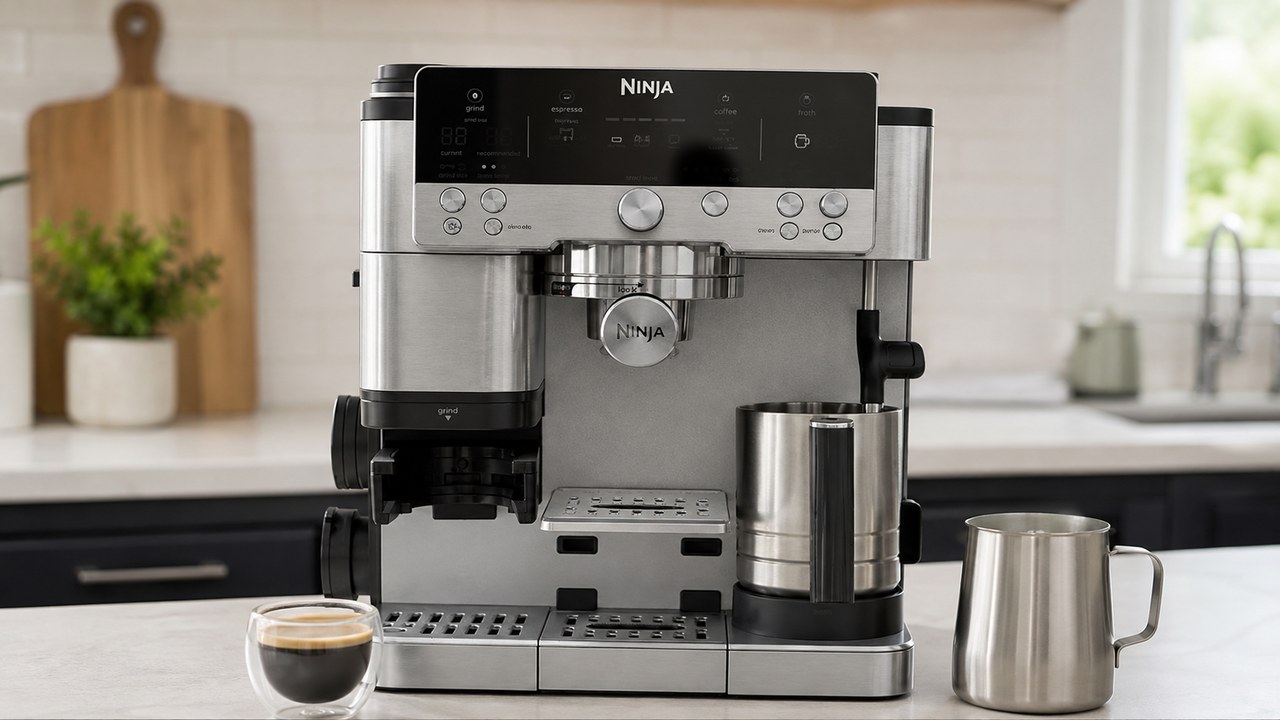
If your Ninja Luxe Café is not brewing correctly, start with the symptom rather than changing several settings at once. Many apparent faults on the Ninja Luxe Café Premier ES601 come from water-reservoir seating, grind size, basket blockage, maintenance requirements or the machine’s normal pressure-management system.
This Ninja Luxe Café troubleshooting guide covers the most common ES601 problems and the checks worth making before assuming the machine needs repair. It is written primarily for the U.S. Ninja Luxe Café Premier Series ES601; controls and procedures on similarly named models sold in other regions can differ.
Ninja Luxe Café troubleshooting at a glance
| Problem | Check first |
|---|---|
| No water from the portafilter | Water level, reservoir seating, grind size and scale buildup |
| Espresso flows very slowly | Grind may be too fine or basket may be restricted |
| Espresso flows too quickly | Grind may be too coarse or puck resistance too low |
| No crema | Bean freshness, grind size, tamp and basket cleanliness |
| Drip tray fills quickly | Some water in the tray is normal on this machine |
| Coffee is not hot enough | Preheating, brew temperature and descaling |
| Machine is leaking | Drip tray, reservoir seating and group-head area |
| Machine has no power | Outlet, plug, power button and automatic shutoff |
| Message remains on display | Follow the specific ADD WATER, ADD BEANS or installation prompt |
| Er followed by a number | Stop normal troubleshooting and contact Ninja support |
No water is coming out of the portafilter
If the ES601 appears to run but little or no water reaches the portafilter, begin with the water supply. Make sure the reservoir contains enough water for the selected drink and is seated firmly against the back of the machine.
Next, consider the grind. Espresso ground much finer than the machine recommends can create enough resistance to dramatically slow or stop flow through the coffee puck. If the machine times out during the brew, do not immediately repeat the shot with the same settings. Let it finish, discard the puck and try the recommended grind setting on the next dose.
A dirty basket can cause a similar symptom. Remove the basket and inspect the holes from both sides. Coffee residue should not be allowed to block the openings.
If water flow has gradually become worse despite correct reservoir seating, grind settings and a clean basket, scale buildup becomes more likely. A machine asking for descaling should not have that warning repeatedly ignored.
Espresso is flowing very slowly
A slow espresso stream does not automatically mean the pump is failing. On the Ninja Luxe Café, the coffee itself can create excessive resistance if the grind is too fine.
- Compare the current grind setting with the setting recommended by the machine.
- Check the basket holes for compacted coffee residue.
- Clean loose grounds from the basket rim before locking the portafilter into the group head.
- Descale the machine if maintenance is due or flow has gradually deteriorated.
Change one variable at a time. Making the grind dramatically coarser while simultaneously changing dose, beans and strength makes it difficult to identify what actually corrected the extraction.
Espresso is flowing too fast
Very fast flow usually points in the opposite direction: there is too little resistance through the coffee puck. The grind may be too coarse, or the coffee may not have been tamped firmly and evenly enough.
Use the machine’s recommended grind setting as your starting point rather than assuming that one grind number will work with every coffee. Bean age, roast level and the individual beans can all change the setting needed for a balanced extraction.
Ninja Luxe Café has little or no crema
Poor crema is often an extraction or coffee-freshness issue rather than a machine failure. Check the grind before changing unrelated settings. A grind that is too coarse allows water to pass through too easily and can produce a thin shot with weak crema.
Also consider the beans. Freshly roasted coffee generally behaves very differently from beans that have been open for a long time. If the grind and preparation look correct but crema has gradually disappeared with the same bag of coffee, freshness may be the explanation.
Finally, inspect the basket. Blocked holes can interfere with extraction, while uneven preparation of the puck can cause water to find an easier path through the coffee.
The drip tray fills with water quickly
Water appearing in the drip tray is not necessarily a leak. The Ninja Luxe Café intentionally sends some water into the main drip tray as part of pressure management during brewing. It also purges water from the steam system after frothing.
That means a drip tray that contains water after normal use can be completely normal. The question is whether the amount and location have changed.
- Normal: water gradually accumulates in the drip tray during brewing and frothing.
- Investigate: water appears underneath or behind the machine rather than in the tray.
- Investigate: the tray suddenly fills much faster than it did under the same usage pattern.
- Investigate: water escapes around the portafilter while espresso is brewing.
Coffee is not hot enough
If the espresso is warmer than room temperature but not as hot as expected, first eliminate heat loss outside the machine. A cold portafilter and a cold ceramic cup can absorb a surprising amount of heat from a small espresso.
- Preheat the portafilter with hot water, then dry the basket before adding coffee.
- Warm the cup before brewing.
- Check the selected brew-temperature setting. For the full ES601 menu, including brew temperature, froth temperature, strength, Barista Assist, resets and h01–h08, see our Ninja Luxe Café settings guide.
- Run the required descaling procedure if maintenance is due.
Do not judge brew-temperature problems from milk drinks alone. The temperature of the milk, amount of milk and selected froth setting can change the final drink temperature even when the espresso side is operating normally.
Coffee tastes too bitter or too acidic
Taste problems are frequently caused by extraction rather than a defective machine. Start by matching the grind to the recommendation shown by the Ninja Luxe Café instead of compensating immediately with multiple other adjustments.
If the shot remains unbalanced, brew temperature can also be used deliberately. Darker roasts generally need less aggressive heat than lighter roasts, while lighter coffee may benefit from a higher brew temperature.
Make small adjustments and taste again. Moving several grind steps while also changing temperature and strength makes troubleshooting much less useful.
Drink is smaller or larger than expected
If the ES601 suddenly produces noticeably more or less coffee than expected, first separate an espresso-volume problem from a drip-coffee size problem. The machine handles those two situations differently.
For espresso, the grounds-to-water ratio can affect the final output. Check the ratio setting before compensating by making large grind changes. For coffee, make sure the intended drink size is selected with the SIZE control before grinding and brewing.
- Confirm the correct drink and size are selected.
- For espresso, check the grounds-to-water ratio in the machine settings.
- Inspect the basket for blocked holes if output has gradually decreased.
- Descale the machine if maintenance is due or water flow has become progressively weaker.
If the same settings previously produced consistent volumes and the output now varies dramatically from one brew to the next, that is more significant than a small difference caused by changing beans or drink settings.
Why the Ninja Luxe Café makes a pulsing or thumping sound
A pulsing or thumping sound during brewing does not automatically mean the pump is failing. Some pump noise is normal on the Ninja Luxe Café, and similar sounds can also occur while the machine is frothing.
If the sound seems stronger than usual, check the water reservoir first. Make sure it contains enough water and is firmly seated against the machine. A poor water supply can make pump noise more noticeable.
The sound becomes more useful as a troubleshooting clue when it appears together with another new symptom, such as little or no water flow, repeated interruptions during brewing or a reservoir that is not feeding correctly. In that situation, troubleshoot the water-flow problem rather than the sound alone.
Ninja Luxe Café is leaking
First determine where the water is actually coming from. Water inside the drip tray may be normal, while water running across the counter is not.
Remove and reseat the water reservoir and check that the drip tray is not already full. If water appears around the portafilter during brewing, turn the machine off after the cycle and inspect the basket rim for coffee grounds that could prevent a clean seal.
A recurring leak from the group-head area despite correct portafilter installation and a clean rim can indicate a sealing problem. That is different from routine cleaning or adjustment and may require service or replacement of the relevant seal.
Ninja Luxe Café will not turn on
Start with the simple checks before treating this as an internal electrical failure.
- Make sure the power cord is fully connected to a working outlet.
- Test the outlet with another appliance if necessary.
- Press the machine’s power button after connecting it.
- Remember that the ES601 can shut itself off automatically after a period of inactivity.
If the outlet works but the machine remains completely dead, repeatedly plugging and unplugging it is unlikely to solve an internal electrical fault. Stop there rather than opening the machine.
What the Ninja Luxe Café display messages mean
Several messages that look like errors are actually instructions telling you what the machine needs before it can continue.
| Message | What to check |
|---|---|
| ADD WATER | Fill the reservoir or remove and firmly reseat it. |
| ADD BEANS | Check the hopper and make sure beans can feed toward the burrs. |
| INSTALL PORTAFILTER | Seat the portafilter correctly in the grinding cradle. |
| INSTALL FUNNEL | Check that the funnel is correctly aligned and attached. |
| INSTALL HOPPER | Seat and lock the bean hopper correctly. |
| INSTALL JUG | Place the milk jug correctly on its platform and keep the contact area clean and dry. |
| RINSE | Complete the requested rinse procedure. |
| DESCALE | Run the descaling procedure. |
| CLEAN | Run the required cleaning cycle. |
What to do if the display shows an Er code
An Er message followed by a number is different from routine prompts such as ADD WATER or INSTALL HOPPER. It indicates a condition that Ninja directs owners to customer support rather than a normal user troubleshooting procedure.
Write down the complete code before turning the machine off. If the code returns, contact Ninja with the exact model number and error code rather than attempting to dismantle the machine.
What if the frother is not working?
For a frothing cycle that will not start, make sure the machine has reached operating temperature, the reservoir contains enough water, the steam wand is lowered correctly and the milk jug is properly positioned on its platform. Also make sure there is enough milk in the jug for the selected cycle.
Problems involving weak foam, incorrect milk temperature, a clogged wand or repeated frother failures need more targeted troubleshooting than the general checks above. See our Ninja Luxe Café frother troubleshooting guide for the full diagnostic sequence.
What if the grinder is not working?
If no grounds are coming from the grinder, first confirm that beans are present, the hopper is correctly installed and locked, and the portafilter and funnel are correctly positioned in the grinding cradle. Coffee debris around the cradle can also prevent correct detection or positioning.
If the grinder makes unusual noise, repeatedly jams, shows ADD BEANS with a full hopper, or still produces no grounds after the basic checks, use our Ninja Luxe Café grinder troubleshooting guide for the full diagnostic sequence.
When descaling is worth trying
Scale can affect more than taste. Mineral buildup can reduce water flow and contribute to temperature and brewing problems, particularly if the machine is used with hard water.
Descaling is therefore a sensible troubleshooting step when the machine requests it or when water flow has gradually deteriorated. For the complete ES601 procedure, including powder or vinegar quantities, the 90-minute cycle, rinse steps, and what to do if the DESCALE light stays on, see our Ninja Luxe Café descale guide.
When to stop troubleshooting the ES601
Owner troubleshooting should stop when the next step would require opening the machine, bypassing a safety feature or working on internal wiring, heaters, pumps or pressurized water connections.
- An Er code repeatedly returns after restarting the machine.
- Water is entering the electrical or lower internal area of the machine.
- The power outlet is known to work but the machine remains completely dead.
- There is a burning smell, visible electrical damage or abnormal overheating.
- A persistent group-head leak remains after normal cleaning and correct portafilter installation.
For those faults, record the exact symptoms and any display message before contacting Ninja or an appropriately qualified repair technician. A precise description of what the ES601 does—and at what point in the brew cycle it happens—is much more useful than simply reporting that the machine is not working.
A better way to troubleshoot the Ninja Luxe Café
The quickest way to make troubleshooting confusing is to change everything at once. Start with water supply and machine messages, then check the part directly involved in the symptom. For espresso-flow problems, focus on reservoir seating, grind size, basket condition and maintenance. For taste problems, work through grind, beans and temperature one adjustment at a time.
Just as importantly, learn what is normal for the ES601. Water entering the drip tray, automatic purging and changes in recommended grind settings do not automatically indicate a defective machine. Once those normal behaviors are separated from genuine faults, most Ninja Luxe Café problems become much easier to diagnose.