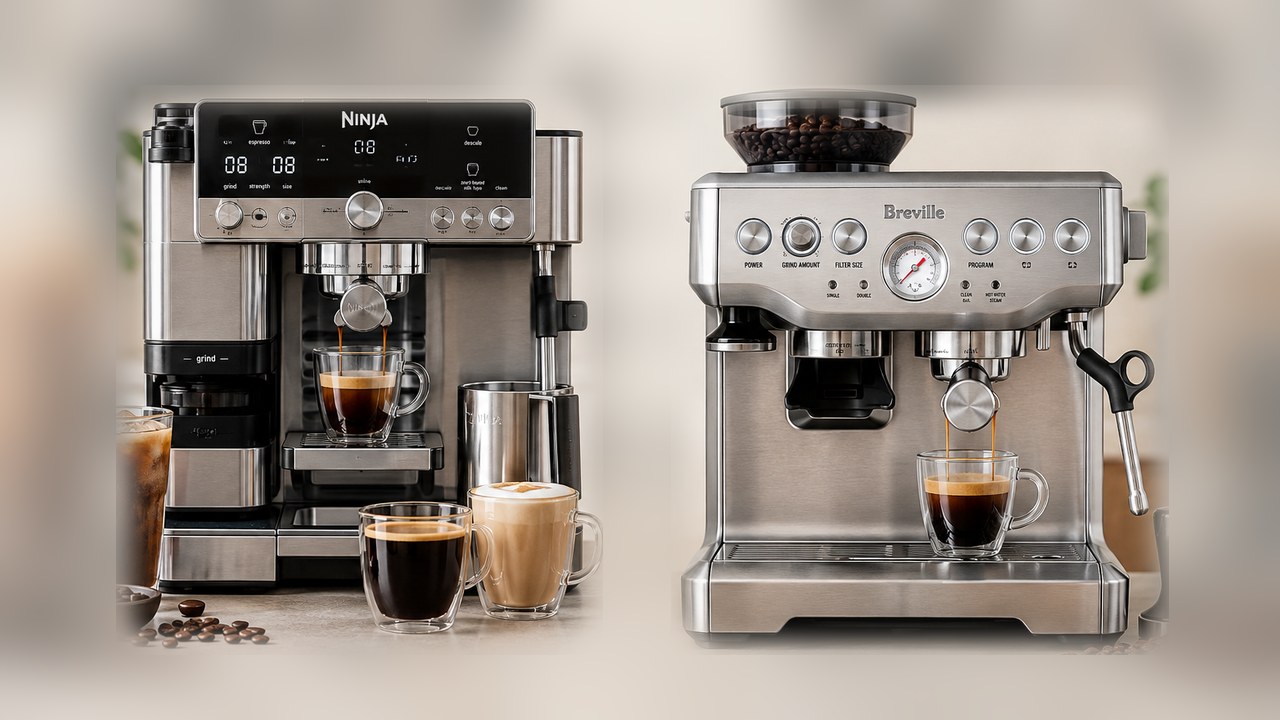
The Ninja Luxe Café Premier ES601 and Breville Barista Express BES870XL both combine a grinder and espresso machine in one appliance, but they are built for very different owners. The Ninja guides more of the process for you and also makes drip coffee and cold brew. The Breville gives you a more traditional hands-on espresso workflow with a pressure gauge, manual steam wand, and greater direct control over extraction.
If you want the shortest answer, choose the Ninja Luxe Café Premier for convenience and drink variety. Choose the Breville Barista Express if learning and controlling espresso is part of the appeal.
This comparison covers the U.S. Ninja Luxe Café Premier ES601 and the original Breville Barista Express BES870/BES870XL. It does not cover the Barista Express Impress, Barista Pro, or Ninja Luxe Café Pro.
Ninja Luxe Café Premier vs Breville Barista Express at a glance
| Feature | Ninja Luxe Café Premier ES601 | Breville Barista Express BES870XL |
|---|---|---|
| Best for | Guided, versatile coffee making | Hands-on espresso |
| Integrated grinder | Yes | Yes |
| Grind settings | 25 | 16 on current U.S. product page |
| Dosing | Weight-based with built-in scale | Grind amount / dose control |
| Grind recommendations | Yes, Barista Assist | No automatic recommendation |
| Tamping | Separate assisted tamper + funnel | Manual tamper |
| Pressure gauge | No | Yes |
| Portafilter | Ninja-specific system | 54mm stainless steel |
| Milk frothing | Hands-free Dual Froth System | Manual steam wand |
| Drip coffee | Yes | No |
| Cold brew | Yes | No |
| Dedicated hot-water outlet | No independent hot-water system | Yes |
| Typical price when checked | Around $600 | Around $700 |
Those differences matter more than small specification advantages. One machine is designed to guide a broad coffee routine; the other is designed to let you practice espresso.
Quick verdict: Ninja for convenience, Breville for control
The Ninja Luxe Café Premier is the better choice for most people who want café-style drinks without turning espresso into a hobby. It weighs the dose, recommends grind changes, automates milk frothing, and can switch from espresso to regular coffee or cold brew.
The Breville Barista Express is the better choice if you want to learn the espresso process. You decide how to dial in the grinder, watch the pressure gauge, tamp manually, control the shot, and texture the milk yourself.
Neither approach is automatically better. The important question is whether you want the machine to reduce variables or expose them.
The Ninja guides you; the Breville expects you to dial in
This is the biggest difference between the two machines.
The ES601 uses Barista Assist Technology to recommend grind settings and make automated brew adjustments. Its built-in scale weighs the coffee rather than relying only on how long the grinder runs.
The Barista Express gives you tools rather than recommendations. Its grinder dispenses coffee according to the grind-amount controls, and you evaluate the extraction using flow, taste, timing, and the pressure gauge.
That makes the Ninja easier to approach when you change beans or are still learning espresso. The Breville can be more satisfying if making those decisions yourself is exactly what you want.
Grinder: 25 settings vs 16 settings
The Ninja Luxe Café Premier has a conical burr grinder with 25 grind settings covering espresso through drip coffee.
Breville’s current U.S. Barista Express product page lists 16 grind settings for its integrated conical burr grinder.
More numbered settings do not automatically mean better espresso. The Ninja needs a wider grinding range because it also prepares drip coffee and cold-brew-style drinks. The Barista Express is fundamentally an espresso-focused machine.
The more important difference is guidance: the Ninja tells you which direction to move, while the Breville expects you to interpret the shot yourself.
Dosing: Ninja’s built-in scale is a major convenience advantage
The ES601 uses weight-based dosing. A built-in scale measures the coffee dose for the selected drink.
The Barista Express uses its grinder and GRIND AMOUNT control to dispense coffee, but it does not automatically weigh each dose for you.
You can absolutely make repeatable espresso on the Breville, but owners who want tight dose consistency often add a separate coffee scale to their workflow.
For someone who wants fewer accessories and fewer measurements to manage manually, the Ninja system is simpler out of the box.
Tamping is manual on both, but the workflow is different
The ES601 Premier comes with an assisted tamper and funnel. After grinding, you keep the funnel on the portafilter, place it on a stable surface, and use the supplied assisted tamper.
The Barista Express also requires manual tamping. Its tamper stores on the machine, and Breville includes a dosing funnel to reduce loose grounds during preparation.
Neither machine in this comparison has the ES701 Pro’s lever-operated integrated tamping system. That feature is outside the scope of this ES601 vs BES870XL comparison.
Breville gives you more direct espresso feedback
The Barista Express has a visible espresso pressure gauge. During extraction, the gauge gives you another clue about how much resistance the coffee puck is creating.
It also uses low-pressure pre-infusion followed by 9-bar extraction, and its thermocoil system uses PID temperature control.
The Ninja takes a different approach. Rather than asking you to interpret a pressure gauge, Barista Assist monitors the brewing process and guides future grind adjustments.
If you want to understand the Breville’s grind, dose, and temperature controls in detail, use our Breville Barista Express settings guide. This comparison intentionally keeps those adjustments at a high level.
Which one gives you more espresso control?
The Barista Express wins if by “control” you mean direct involvement.
- You choose and evaluate the grind.
- You control the dose more manually.
- You tamp the puck yourself.
- You can watch extraction pressure.
- You can run preset or manual shot volumes.
- You texture the milk manually.
The Ninja wins if by “control” you mean getting a repeatable result without having to manage every variable yourself.
That distinction is more useful than simply calling one machine more advanced.
Portafilter and accessory ecosystem
The Breville Barista Express uses a 54mm stainless-steel portafilter and has been on the market long enough to develop a very large ecosystem of baskets, tampers, dosing funnels, puck screens, bottomless portafilters, and other accessories.
The Ninja uses its own Luxe Café portafilter and basket system. Third-party accessories exist, but compatibility needs more care because a similar advertised diameter does not guarantee the part will work correctly with the Ninja workflow.
If modifying and experimenting with an espresso setup is part of the hobby for you, the Barista Express has the stronger accessory ecosystem.
Milk frothing: automatic vs manual
For milk drinks, the machines could hardly be more different.
The Ninja’s Dual Froth System combines steam and whisking to create textured milk hands-free. You select the milk type and froth style, place the jug under the system, and let the machine handle much of the process.
The Breville gives you a traditional manual steam wand. You position the tip, introduce air, create the vortex, monitor temperature, and stop when the texture is right.
Choose Ninja milk frothing if:
- You want consistent milk without learning steaming technique.
- Several people in the household use the machine.
- You regularly switch between dairy and plant-based milk.
- Convenience matters more than manually controlling every texture change.
Choose Breville milk frothing if:
- You want to learn traditional steam-wand technique.
- You want direct control over how much air enters the milk.
- Latte-art practice is part of why you are buying an espresso machine.
A skilled user can create excellent microfoam with the Breville. The Ninja’s advantage is that it asks for much less skill to produce a repeatable milk drink.
The Ninja also makes drip coffee
This is a major advantage if the machine will serve an entire household.
The ES601 is a 3-in-1 system designed for espresso, drip-style coffee, and cold brew. Its grinder changes across a wider range to support those different drinks.
The Barista Express is an espresso machine. You can make an Americano by adding hot water to espresso, but it does not replace a drip coffee maker in the same way the Ninja does.
If one person wants a latte and another wants a regular mug of coffee, the Ninja is much more flexible.
Cold brew is another Ninja-only advantage
The ES601 also includes rapid cold-brew and cold-extraction options.
The Barista Express does not have a dedicated cold-brew program. You can obviously use espresso as the base for an iced drink, but that is different from having a machine designed to prepare cold-brew-style coffee.
If cold drinks are a regular part of your routine rather than an occasional summer extra, this difference can justify the Ninja on its own.
Breville has a dedicated hot-water outlet
The Barista Express includes a separate hot-water outlet. That makes it convenient for Americanos and other small hot-water tasks.
The Premier ES601 does not have the independent hot-water system found on the higher Luxe Café Pro model.
If you drink Americanos frequently and do not want to use a kettle, this is a practical advantage for the Breville.
Which machine is easier for a beginner?
The Ninja Luxe Café Premier is easier for most beginners.
Its biggest advantage is not that espresso suddenly becomes automatic. You still install the correct basket, grind, tamp, and lock in the portafilter. The difference is that the machine gives you more guidance and measures more of the process.
The Breville has a steeper learning curve because several decisions remain yours. A poor grind, inconsistent dose, uneven tamp, or incorrect steam technique is easier to introduce.
That same learning curve is also why some buyers will prefer it.
Which machine is better if you want to learn espresso?
The Breville Barista Express is the stronger teaching machine.
It exposes the relationship between grind, dose, tamping, pressure, shot volume, temperature, and milk technique more directly.
When a shot is wrong, you have to interpret what happened and decide what to change. That can be frustrating at first, but it is also how you develop espresso technique.
The Ninja is better at helping you reach a usable result quickly. The Breville is better at making the process itself part of the hobby.
Which one is better for a busy household?
The Ninja has the advantage here.
- It can prepare more types of coffee.
- The built-in scale reduces dosing guesswork.
- Barista Assist helps when different people use different beans.
- Hands-free frothing requires less technique.
- Cold brew and regular coffee do not require another machine.
If several people want different drinks from one countertop appliance, the ES601 is more versatile.
Cleaning and daily workflow
Both machines require normal espresso-machine maintenance: empty the drip tray, remove spent grounds, clean the portafilter and baskets, wipe milk-contact parts immediately, and follow the machine’s cleaning and descaling procedures.
The Ninja’s automatic milk system saves hands-on effort while frothing, but its broader drink system also means there are several removable components to keep clean.
The Breville’s workflow is mechanically straightforward, but the manual steam wand must be wiped and purged after milk use, and manual puck preparation can create more loose grounds around the grinder and portafilter.
I would not choose between these two based mainly on cleaning. The workflow and drink range matter much more.
Price and value
At the time this comparison was checked, the Ninja Luxe Café Premier was listed around $600 and the Breville Barista Express around $700 in the U.S. market.
Those prices change frequently with promotions, colors, retailer bundles, and seasonal sales, so compare the current checkout price rather than treating a $100 gap as permanent.
If the Ninja remains cheaper, its value proposition is unusually strong because it includes weight-based dosing, hands-free frothing, drip coffee, and cold brew.
The Breville’s value comes from somewhere else: a mature espresso platform, direct control, pressure feedback, and a much larger ecosystem for owners who want to develop the setup over time.
Who should buy the Ninja Luxe Café Premier ES601?
Choose the Ninja if most of these sound like you:
- You want good espresso without learning every variable immediately.
- You want the machine to recommend grind adjustments.
- You value automatic weight-based dosing.
- You want hands-free milk frothing.
- You also drink regular coffee.
- You regularly make cold coffee.
- Several people with different preferences will use the same machine.
If you choose it, our Ninja Luxe Café ES601 setup guide covers first use without duplicating that procedure here.
Who should buy the Breville Barista Express BES870XL?
Choose the Breville if most of these sound like you:
- Espresso is much more important to you than drip coffee or cold brew.
- You want to learn how grind, dose, pressure, and shot volume interact.
- You want to steam milk manually.
- You want a pressure gauge as part of the dial-in process.
- You like the idea of a large 54mm accessory ecosystem.
- You are willing to accept a steeper learning curve.
The Barista Express is not the easier machine in this comparison, but for the right owner that is part of its appeal rather than a disadvantage.
Is the Ninja Luxe Café Premier better than the Breville Barista Express?
For the average household looking for one machine to make many drinks with less technique, the Ninja Luxe Café Premier is the better all-rounder.
For someone specifically interested in espresso as a hands-on skill, the Breville Barista Express is the better fit.
The Ninja wins on guidance, dosing convenience, automatic milk, drip coffee, cold brew, and overall versatility. The Breville wins on direct espresso feedback, manual milk control, pressure visibility, and its established 54mm ecosystem.
Final decision
Buy the Ninja Luxe Café Premier ES601 if your priority is getting several café-style drinks from one machine with less trial and error. Its built-in scale, Barista Assist guidance, hands-free frothing, drip coffee, and cold brew make it the easier appliance to share and the broader coffee system.
Buy the Breville Barista Express BES870XL if espresso itself is the priority and you want to take responsibility for more of the process. Its pressure gauge, 54mm portafilter, manual steam wand, PID-controlled brewing, and mature accessory ecosystem make it better suited to someone who wants to learn rather than delegate.
The Ninja is the better convenience machine. The Breville is the better hands-on espresso machine. Choose based on which description sounds more like the way you actually want to make coffee every morning.