
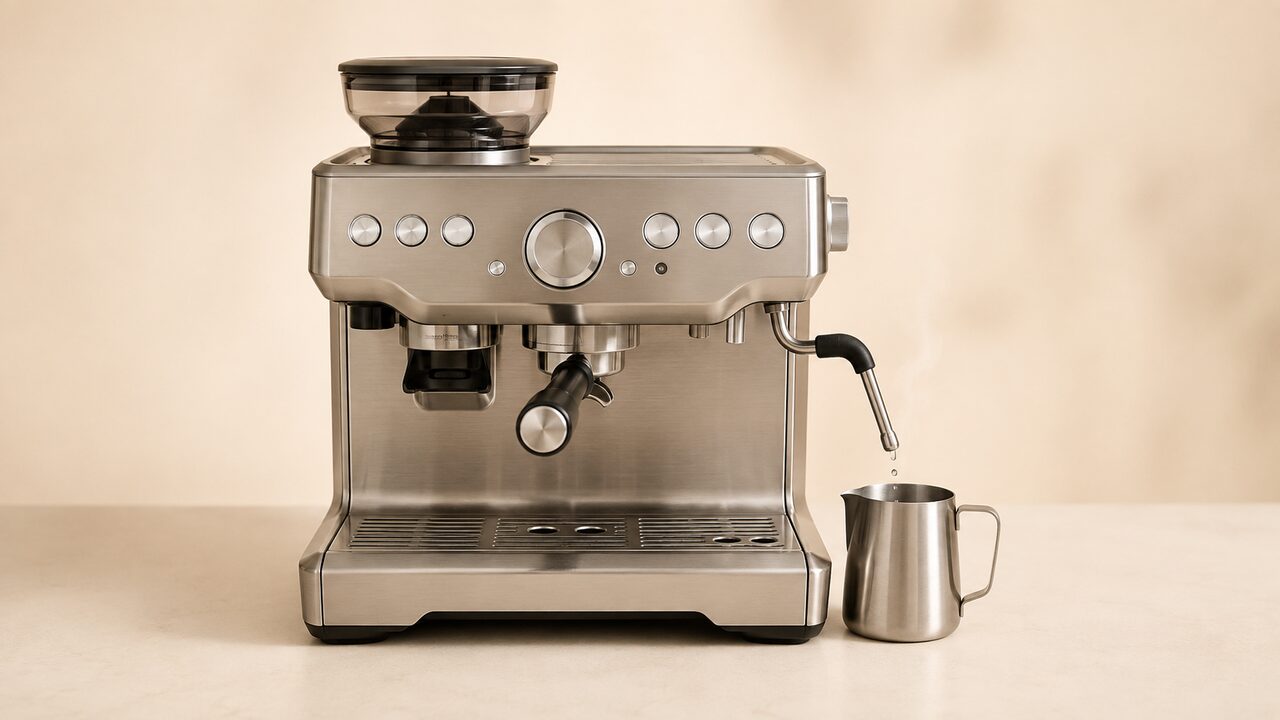
If your Breville Barista Express steam wand is not working, first turn the STEAM/HOT WATER dial fully to STEAM and wait until its light stops flashing. If there is still no steam or the output is weak, fill and firmly reseat the water tank, then clean the cooled steam tip with the supplied tool. Descale the machine if that maintenance is due. Strong steam that heats the milk but creates no foam usually points to milk or technique rather than a failed wand.
This guide covers the Breville Barista Express BES870 series, including the BES870XL sold in North America. It does not cover the Barista Express Impress BES876, which is a different machine.
On this model, “milk frother not working” can describe two different faults: the machine produces no usable steam, or the wand produces normal steam but the milk does not texture. The checks below separate those problems before you clean or descale anything unnecessarily.
Safety first: Steam, hot water and the metal wand can cause burns. Keep the wand pointed at the drip tray during tests, return the dial to STANDBY before touching anything, and switch off, unplug and allow the machine to cool before clearing or removing the steam tip. Do not open the housing or work on internal valves, wiring or the heating system.
Quick diagnosis: match the symptom to the next step
| What happens | What it usually means | What to do first |
|---|---|---|
| The light flashes and some water leaves the wand | The machine is heating and purging condensation | Wait until the light stops flashing |
| No steam after the light becomes steady | Tank, dial, blocked tip, scale or an internal fault | Check the tank and dial, then clean the cooled tip |
| Steam is weak or uneven | One or more tip holes may be partly blocked; scale is also possible | Clean the tip, then descale if due |
| Steam is strong but the milk stays flat | The steam supply works; technique or milk is more likely | Correct the tip depth, vortex and milk temperature |
| Water spits briefly, then steam becomes strong | Normal condensation during heat-up | Purge over the drip tray before adding milk |
| Steam, hot water and group-head flow are all weak | A broader water-delivery or scale problem is more likely | Follow the general machine troubleshooting path |
| Steam stops after prolonged continuous use and the light flashes | The five-minute steam limit has been reached | Return the dial to STANDBY |
Run this short steam test before taking anything apart
- Fill and reseat the tank. Use cold water, then push the tank completely down into its locked position. Do not run the pump with an empty tank.
- Let the machine reach its normal ready state. The POWER light should stop flashing and the control-panel lights should be illuminated.
- Aim the wand into the drip tray. Keep your hands away from the tip and turn the STEAM/HOT WATER dial fully to STEAM, not partway.
- Watch the steam light. It flashes while the machine heats for steam. Condensed water may leave the wand during this stage, and a pulsing pump sound is normal. Judge the output only after the light stops flashing.
- Observe one short burst. Once ready, a clear, forceful jet shows that the machine can produce steam. Return the dial to STANDBY before moving the wand.
- Compare the hot-water function separately if steam is missing. After the machine has returned to its ready state, test the dedicated hot-water outlet briefly. This comparison helps separate a local steam problem from a wider water-delivery problem.
If the tank is full and seated but the group head, hot-water outlet and steam wand are all weak or dry, use the complete Barista Express BES870 troubleshooting guide. That pattern is broader than a blocked steam tip.
How to fix a Barista Express with no steam
Work through these checks in order. Retest after each one so you know which change solved the problem.
- Wait for steam temperature. The machine is not ready merely because it can brew espresso. Turn the dial to STEAM and wait for the STEAM/HOT WATER light to stop flashing.
- Return the dial fully to STANDBY, then select STEAM again. A dial left between positions may not select the function correctly. Turn it completely to the right for steam.
- Check the water tank. Fill it and press it down firmly. A tank that looks installed can still fail to supply water if it is not fully seated.
- Clear the steam-tip holes. Dried milk can seal a hole even when the outside looks clean. Use the safe cleaning procedure below.
- Descale when required. Mineral buildup can reduce steam power inside the water path. Use the descale procedure for your exact manual, not the cleaning-tablet cycle.
If the light reaches the ready state, the tank and dial are correct, the cooled tip is clear and the approved descaling process makes no difference, the remaining fault is not a routine external adjustment. Arrange service rather than repeatedly running the pump or opening the machine.
Clean and unblock the steam tip safely
A blocked or partly blocked tip is the most useful owner-serviceable check because milk residue can restrict one or more outlet holes. Follow Breville’s sequence:
- Return the STEAM/HOT WATER dial to STANDBY. Switch off and unplug the machine, then allow the wand and tip to cool completely.
- Wipe the outside of the wand with a damp cloth.
- Use the pin on the supplied cleaning tool to clear each tip hole. Do not use a drill bit or force an oversized object through a hole, because enlarging it changes the steam pattern.
- If the holes remain blocked, use the integrated wrench in the supplied cleaning tool to remove the cooled tip. Soak the tip in hot water, clear the holes with the tool and reinstall it securely.
- Refill and reseat the tank, switch the machine on and let it become ready. Point the wand over the drip tray and run one brief steam purge to confirm the flow.
Do not loosen a hot tip, put your fingers near an active wand or aim steam into a blocked hole while inspecting it. If the tip is damaged, will not reinstall correctly or leaks at its connection, stop using the steam function and obtain the correct part or service.
What to do when the steam is still weak
If clearing the tip improves the pattern but the wand still lacks power, look at maintenance status next. Scale can restrict the steam and hot-water paths even when the outside of the wand is spotless.
| Maintenance action | What it addresses | Will it fix the steam path? |
|---|---|---|
| Wipe and briefly purge the wand after milk | Fresh milk on and immediately inside the tip | Helps prevent a local blockage |
| Use the supplied pin or soak the removed tip in hot water | Dried milk blocking the tip holes | Yes, if the restriction is in the removable tip |
| Run the cleaning-tablet cycle | Coffee oils in the brewing path | No; it is not the steam-system descale procedure |
| Run the documented descale cycle | Mineral buildup in the coffee, steam and hot-water paths | It can help when scale is the cause |
On the current U.S. BES870 manual, a solid CLEAN/DESCALE light calls for descaling, while a flashing light calls for the separate cleaning cycle. The descale mode treats the coffee, steam and hot-water components separately. Follow the complete sequence in the official U.S. Barista Express instruction manual, including its fresh-water rinse.
Do not substitute a cleaning tablet for descaler or strengthen a homemade acid mixture based on forum advice. Manuals and supplied products can differ by region and machine revision, so use the instructions that came with your own BES870/BES870XL if they differ from the U.S. manual.
Why the wand spits water before producing steam
A short release of water while the steam light is flashing is normal. It is condensed water being purged as the thermocoil heats to steam temperature. Keep the wand over the drip tray and wait until the light stops flashing before putting it into milk.
The pumping or pulsing noise heard at the same time is also normal on the BES870. After steaming, the machine may discharge water into the drip tray through its automatic purge system; that does not mean the wand is leaking.
It is not normal for the ready wand to continue delivering only cool water, for the steam light never to finish flashing, or for steam power to disappear completely after the normal warm-up. If the tank, dial, tip and descale checks are complete, those symptoms need service.
Steam is strong, but the milk will not froth
If a ready wand produces a forceful jet and heats the milk, the steam system is working. Flat milk, large bubbles or no microfoam then points more strongly to the milk, wand position or timing. The Barista Express uses a manual wand, so it does not create foam automatically.
- Start with fresh, cold milk. Fill the supplied jug to just below the V at the bottom of its spout rather than overfilling it.
- Purge before the milk. Turn the dial to STEAM over the drip tray and wait until the steam light stops flashing. Return the dial to STANDBY briefly.
- Position the tip correctly. Within the eight-second pause, place it about 1/4–3/4 inch (1–2 cm) below the milk surface near the right side of the jug, then turn the dial back to STEAM.
- Create a vortex. Keep the tip just under the surface until the milk spins. Lower the jug slightly to introduce air, then raise it enough to keep the tip below the surface while the milk continues to roll.
- Stop before overheating. Breville’s BES870 manual gives 140–149°F (60–65°C) as the finished milk range. Turn the steam off before removing the tip from the milk.
- Clean immediately. Wipe the wand with a damp cloth and briefly purge it toward the drip tray so milk is not left to dry inside the tip.
Large bubbles usually mean too much air was added or the tip spent too long above the surface. A high-pitched screech with little volume increase usually means the tip is too deep to draw in air. Different dairy and plant-based milks can texture differently, so judge the machine first with steam strength and milk heating, not foam volume alone.
Use hot water and group-head flow to narrow the fault
The comparison below cannot identify a failed internal part, but it can stop a local wand blockage from being confused with a machine-wide water problem.
| Test result | Most useful conclusion |
|---|---|
| Group-head and hot-water flow are normal, but steam is weak | Focus on the tip, steam-path scale and then professional service |
| Hot water is normal and steam is completely absent after warm-up | The tank can supply water; a steam-specific fault remains possible after tip cleaning |
| Steam, hot water and group-head flow are all weak | Look beyond the wand at tank seating, scale or broader water delivery |
| Steam is strong and milk heats, but foam is poor | Correct milk choice, tip depth, aeration and vortex before suspecting hardware |
Do not repeatedly cycle a dry or silent machine to gather more evidence. One short comparison is enough. Internal possibilities such as a valve, thermocoil, pump or control fault require proper diagnosis and are not owner adjustments.
When to contact Breville or a service provider
- The wand produces no steam after the machine reaches the steam-ready state, even though the tank, dial and cooled tip have been checked.
- Approved tip cleaning and a correctly completed descale cycle do not improve unusually weak steam.
- The STEAM/HOT WATER light never reaches its ready state, or the wand continues to emit only cool water.
- The steam control is loose, stuck or accompanied by uncontrolled leakage.
- The machine overheats, trips a breaker, smells burned or makes a new abnormal noise.
- The machine is new or under warranty and the controlled checks point to a defect.
Do not open the case to replace a steam valve, probe electrical parts or alter the heating and pressure system. Those repairs combine electricity, hot water and pressure and should be handled by Breville or a qualified service provider.
Prevent the steam wand from blocking again
- Wipe the wand with a damp cloth immediately after every milk session.
- Briefly purge the wand over the drip tray after wiping it.
- Never leave the tip sitting in milk after steaming.
- Replace the water filter on the schedule in your manual and more often when your water conditions require it.
- Run the correct descale procedure when the solid CLEAN/DESCALE indicator calls for it.
- Keep the cleaning-tablet cycle and the descale cycle separate; they treat different deposits and water paths.
Barista Express steam wand FAQs
Why does the steam wand take time to start?
The BES870 must heat from brewing temperature to steam temperature. The STEAM/HOT WATER light flashes during that transition and stops flashing when the wand is ready. Water purging during the wait is normal.
Should the pressure gauge move while steaming?
No specific steam reading should be expected from it. Breville identifies the dial as an espresso extraction pressure gauge, not a steam-pressure gauge. Diagnose steaming by the ready light and wand output instead.
Can a cleaning tablet fix weak steam?
Not by itself. The cleaning-tablet cycle targets coffee residue in the brewing path. Mineral restriction in the steam circuit requires the documented descale process, while dried milk in the tip requires direct tip cleaning.
Why does the drip tray fill after steaming?
The Barista Express automatically purges water into the drip tray after steam, hot-water and espresso functions to return the thermocoil to its operating temperature. Water entering the tray through that system is normal.
Why did steam stop after several minutes?
The BES870 disables the steam function after five minutes of continuous steaming. The STEAM/HOT WATER light flashes when this happens. Return the dial to STANDBY rather than treating the cutoff as a blocked wand.
Can I use vinegar to restore steam pressure?
Use the descaling product and dilution specified for your machine instead of copying an improvised vinegar concentration from a forum. The current U.S. BES870 instructions specify Breville descaling powder and a defined rinse sequence for the coffee, steam and hot-water components.
Does this guide apply to the Barista Express Impress?
No. This diagnosis is for the Barista Express BES870/BES870XL. The Barista Express Impress BES876 has different controls and should be checked against its own manual and support information.
The fastest reliable rule is to separate steam supply from milk texturing. No or weak output after the ready light points to the tank, dial, tip, scale or service; a strong jet that heats milk points to technique and milk choice.