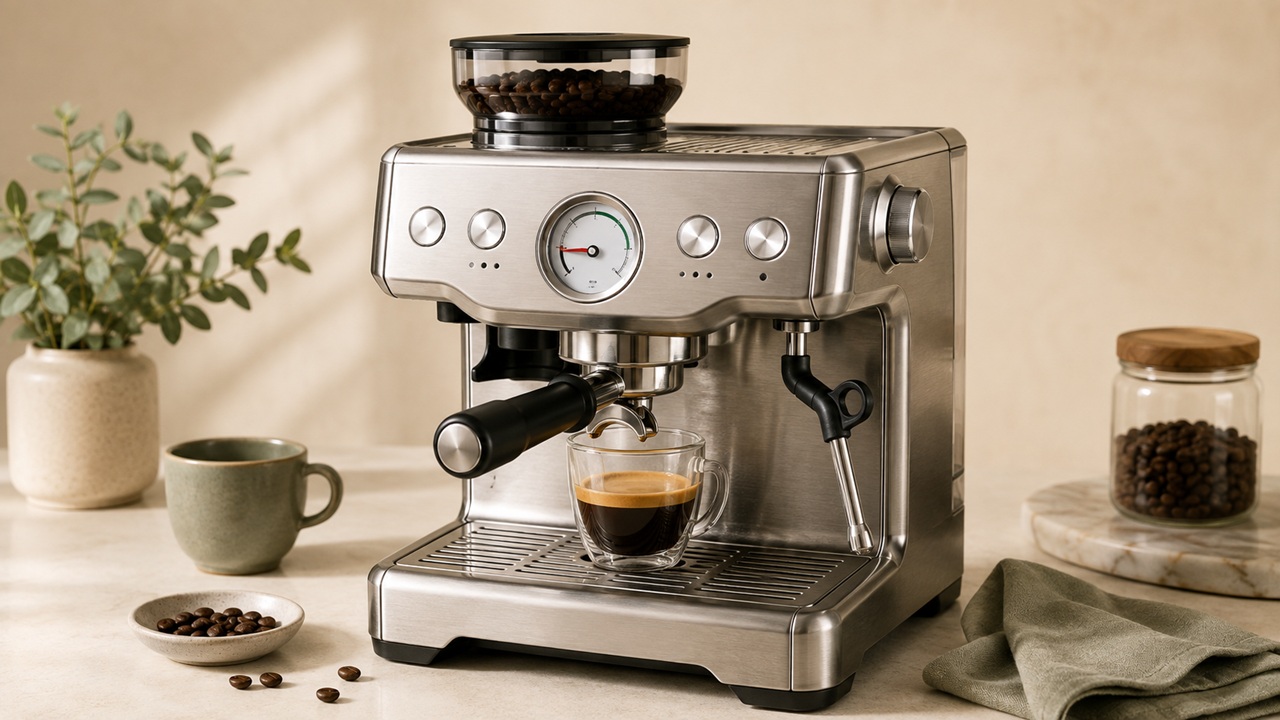
If your Breville Barista Express pressure gauge is low, high or not moving, do not assume the pump has failed. On the BES870 and BES870XL, the gauge responds to the resistance created by the coffee puck during extraction. A fast, pale shot usually needs more resistance; slow drips or no espresso usually need less.
The most useful clue is not the needle alone but the combination of gauge position, flow speed and taste. A gauge that stays low while water runs freely without the portafilter can be normal because there is almost no puck resistance. A gauge that stays at zero during a properly prepared shot while the espresso flows normally may indicate a gauge problem instead.
This guide applies to the Breville Barista Express BES870 series, including the BES870XL sold in North America. It does not cover the Barista Express Impress BES876, which uses a different dosing and tamping system.
Safety first: Never remove the portafilter during extraction. Stop the test if no espresso is flowing, and switch off and unplug the machine before cleaning a blocked basket or handling the burrs. Do not open the housing or adjust internal pressure components.
Quick diagnosis: match the gauge to the flow
| What you see | Most likely direction | First adjustment |
|---|---|---|
| Low or no gauge movement, fast watery shot | Too little puck resistance | Grind slightly finer |
| Low pressure and a thin, pale shot | Coarse grind, low dose, stale coffee or wrong basket | Check basket and dose, then adjust finer |
| Needle above the espresso range, slow drips or no flow | Too much puck resistance | Grind slightly coarser |
| Gauge does not move, but shot flow and taste are normal | Gauge or gauge-path fault is possible | Stop chasing the grind and consider service |
| Weak or no water with the portafilter removed | Machine-side water-delivery problem | Check the tank, warm-up and maintenance status |
What the Barista Express pressure gauge actually measures
The gauge monitors extraction pressure, not pump health in isolation. When water meets a prepared coffee puck, the grind, dose, basket and puck preparation create resistance. The needle shows the pressure produced against that resistance.
The machine deliberately starts with low-pressure pre-infusion before moving to full extraction pressure. Breville describes the full extraction as 9 bar, delivered by a pump rated at 15 bar. That does not mean the needle should display 15 bar: the BES870 gauge face uses an espresso range rather than numbered bar markings.
Use the marked range as a guide, then judge the shot by its flow and taste. The exact midpoint is not a target worth pursuing if the espresso is already balanced.
Run this controlled check before changing the grind
- Let the machine become ready. Fill and firmly reseat the water tank, return the STEAM/HOT WATER dial to STANDBY and wait until the POWER light stops flashing.
- Check group-head flow without the portafilter. Run one short 1 CUP purge. A normal stream means the machine can deliver water through the group head. Little or no flow is not a coffee-pressure adjustment problem; use the complete BES870 troubleshooting guide to follow the water-delivery branch.
- Choose the correct basket. Use a Single Wall basket with freshly ground whole beans. Use a Dual Wall basket for pre-ground coffee; it regulates pressure to compensate for less control over grind and freshness.
- Start with a controlled dose. Breville lists approximately 8–11 g for the 1 CUP basket and 16–19 g for the 2 CUP basket. Tamp level and consistently rather than trying to force the gauge upward.
- Watch the whole extraction. Note when the first drops appear, how the stream behaves, where the needle settles after pre-infusion and how the espresso tastes.
- Change one variable. Grind size usually has the strongest immediate effect. Retest before changing dose or tamp as well.
As starting references, the current U.S. manual says espresso should begin to flow after about 4–7 seconds and lists 25–30 seconds as a balanced extraction time. These are diagnostic guides, not reasons to ignore a shot that tastes good.
A compact espresso scale with a timer helps keep the dry dose and shot yield consistent while you compare pressure changes. It does not measure pump pressure, but it prevents dose and output from changing unnoticed between tests.
How to fix low pressure or no pressure with a fast shot
A needle below the espresso range combined with a fast, pale or watery shot means water is passing through the puck too easily. Make these changes in order:
- Move the grind one step finer. Purge a small amount of retained coffee, prepare another shot and compare the result.
- Check the dose. If the basket is visibly underfilled, increase the grind amount slightly. After tamping, use the supplied Razor tool as the machine’s dose-height reference.
- Distribute and tamp evenly. A tilted or uneven puck can let water bypass one side. Breville specifies 22–33 lb (10–15 kg), but consistency and a level puck matter more than trying to tamp as hard as possible.
- Check coffee freshness and basket type. Older coffee creates less useful resistance in a Single Wall basket. If you are using pre-ground coffee, switch to the appropriate Dual Wall basket.
If the external grind dial is already very fine
Do not jump straight to an internal machine fault. The BES870 has an owner-adjustable upper burr that extends the grinder’s range. First confirm the basket, dose and coffee are appropriate. If the grinder still cannot produce enough resistance, follow the illustrated upper-burr procedure in the manual for your exact machine and move it only one number at a time.
Empty the hopper and grinder as directed before removing the burr, keep the burrs dry and retest. A large adjustment can take the machine from a fast shot to a completely choked basket.
How to fix high pressure, slow drips or no espresso
A needle above the espresso range with only slow drips—or no espresso at all—usually means the puck or basket is too restrictive. Stop the shot instead of repeatedly running the pump against a blockage.
- Move the grind one step coarser and retest.
- Reduce an excessive dose and trim it after tamping with the Razor tool.
- Use a firm, level and repeatable tamp; more force is not a cure.
- Inspect the basket holes after the machine has been switched off and allowed to cool. Clean them only with the supplied cleaning tool and the method in the manual.
If water flows normally through the group head and through the empty basket, but stops only after coffee is added, the restriction is still in the puck preparation. Descaling is not the first response to that pattern.
Why the gauge stays low during pre-infusion
Low pressure at the beginning of a shot is normal. The Barista Express uses pre-infusion to wet and expand the coffee before full-pressure extraction, so the needle can begin low and then rise.
Manual shot control changes the timing. When you press and hold either shot button, the machine remains in low-pressure pre-infusion. Full pressure begins only after you release the button. If the needle stays low while you keep holding the button, release it before diagnosing a fault.
Gauge not moving even though espresso flows
If your Breville Barista Express pressure gauge is not working or not moving, first make sure you are judging it during a loaded extraction rather than an empty group-head purge. A gauge that stays at zero does not always mean the machine has no pressure, so compare the needle with the actual coffee flow before changing the grind.
- Fast, weak shot: treat it as insufficient puck resistance and work through the low-pressure adjustments.
- Normal-looking shot with normal timing and taste: stop making the grind finer just to move the needle. The gauge or its pressure path may be faulty.
- Weak water even without the portafilter: treat it as a water-delivery problem, not a gauge-reading problem.
A nonmoving gauge cannot be confirmed or repaired from outside the housing. If the machine is under warranty, or if the shot behavior and needle clearly disagree, contact Breville or an authorized service provider.
Use the two basket types as a safe comparison
The supplied baskets can help separate puck preparation from a likely machine problem without opening anything.
| Comparison result | What it suggests |
|---|---|
| Dual Wall builds pressure, Single Wall stays low | The machine can create pressure; focus on the fresh-coffee grind, dose and puck preparation |
| Both baskets produce fast flow and little movement | Confirm the dose and basket installation; if preparation is correct, service may be needed |
| Both baskets choke the flow | Check for an excessive dose, a grind that is too fine or blocked basket holes |
| Gauge stays at zero but both produce sensible espresso | The gauge or its pressure path is more suspect than the pump |
This comparison does not measure an exact pressure. It only shows whether changing the basket’s resistance changes the machine’s behavior.
Do not turn the cleaning disc into a pressure test
Online advice often suggests using the cleaning disc as a blind pressure test. Breville documents that disc for the automatic cleaning cycle with the 1 CUP basket and a cleaning tablet—not as a calibrated pump test.
Do not improvise a sealed test, hold the pump against a blockage or infer an exact bar reading from it. Cleaning discs and instructions can also differ by machine or regional revision. Use the disc only in the official cleaning procedure.
When low pressure is really a water-flow problem
Grind and dose cannot correct weak flow from an empty group head. If the short no-portafilter check produces little or no water, confirm that the machine is ready, the tank is full and pushed completely into position, and descaling is not overdue.
Compare the group head with the hot-water outlet once. If both are weak, or if the group head remains dry after the approved maintenance steps, stop. The problem may involve an internal water path, pump or valve and requires proper service rather than a finer grind.
When to contact Breville or a service provider
- The gauge remains at zero during prepared shots even though flow and extraction behavior are otherwise normal.
- There is little or no group-head flow with the portafilter removed after the tank, warm-up and approved maintenance checks.
- Correct basket choice, dose and grind cannot produce a sensible change in either flow or gauge position.
- The machine leaks into the housing, repeatedly overheats, trips a breaker or produces a burning smell or abnormal noise.
- The machine is new or under warranty and the controlled checks point to a fault.
Do not adjust the over-pressure valve, replace the gauge or dismantle pressurized and electrical parts as routine troubleshooting. Use the official U.S. BES870 instruction manual for the approved grinder, basket, cleaning and descaling procedures, and use the manual for your own region if the machine was sold elsewhere.
Barista Express pressure FAQs
Where should the pressure gauge needle sit?
During full extraction, use the marked espresso range as a guide rather than chasing its exact midpoint. A balanced flow and good taste matter more than a specific clock-face position, especially because the gauge is not numbered in bars.
Why does the gauge barely move without the portafilter?
An empty group head provides very little resistance, so a low reading during a water purge does not by itself show a bad pump. Use that purge to judge water flow, then judge pressure during a prepared extraction.
Why did pressure drop after changing coffee beans?
Different beans produce different particle distributions and occupy the basket differently at the same grinder setting. Freshness and roast also affect extraction behavior. Dial in the new coffee with one grind change at a time instead of assuming the machine has changed.
Why is pressure normal with the Dual Wall basket but low with the Single Wall basket?
The Dual Wall basket creates and regulates more of its own resistance. If it moves the gauge but the Single Wall basket does not, the pump can create pressure; the fresh-coffee grind, dose or puck preparation needs adjustment.
Is 15 bar the correct extraction pressure?
No. Fifteen bar is the pump rating. Breville describes the BES870 extraction as 9 bar after low-pressure pre-infusion. The built-in gauge does not provide numbered bar readings, so use its espresso range together with flow and taste.
Can descaling fix low pressure?
Descaling can help when mineral buildup restricts water delivery and the machine is due for the procedure. It will not correct a fast shot caused by a coarse grind or low dose. Check flow without the portafilter before deciding which problem you have.
Should I adjust the OPV to move the gauge?
No. An over-pressure-valve adjustment requires opening the machine and is not an owner troubleshooting step in the instruction manual. First diagnose the basket, grind, dose and water flow. If those checks point to internal pressure control, arrange service.
The quickest reliable rule is simple: read the needle together with the espresso flow. Fast flow needs more puck resistance, slow or stopped flow needs less, and a dead gauge with otherwise normal espresso needs service—not an ever-finer grind.