
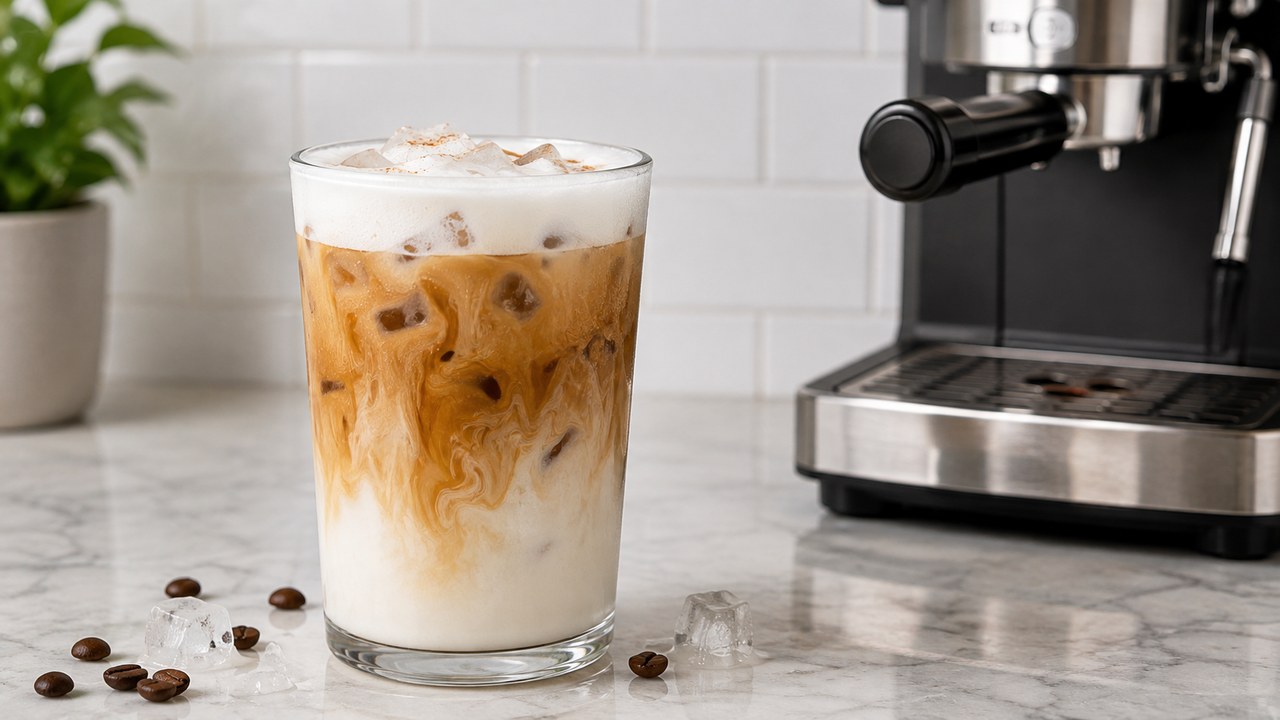
To make an iced latte with the Ninja Luxe Café Pro ES701, brew espresso into a glass with ice, add cold milk, and finish with Cold Foam if you want a café-style top layer. For a typical large iced latte, the Double basket is the best starting point because it gives the coffee enough intensity to stay noticeable after adding milk and ice.
The important distinction is that an iced latte is an espresso-based milk drink. Do not use the ES701’s Over Ice coffee program simply because the final drink contains ice. Over Ice makes concentrated drip coffee; an iced latte starts with espresso.
Ninja Luxe Café Pro iced latte at a glance
| Setting | Recommended starting point |
|---|---|
| Machine | Ninja Luxe Café Pro ES701 |
| Coffee base | Espresso |
| Basket | Double basket |
| Grind | Follow Barista Assist |
| Tamping | Use integrated tamper twice |
| Espresso strength | Default first; stronger if milk overwhelms coffee |
| Milk | Dairy or plant-based |
| Ice | Fill serving glass generously |
| Froth | Cold Foam optional |
| Milk Type | Match DAIRY or PLANT-BASED to the milk used |
What you need
- Fresh whole coffee beans.
- The ES701 Double basket.
- A tall glass.
- Fresh ice.
- Your preferred dairy or plant-based milk.
- Optional vanilla, caramel, brown sugar or another syrup.
You do not need a special type of coffee bean just because the drink is iced. A medium-dark or dark roast is an easy starting point because its espresso flavor usually stays noticeable after milk and ice are added.
How to make an iced latte on the Ninja Luxe Café Pro ES701
1. Install the Double basket
Place the Double basket inside the portafilter and make sure it is fully seated.
A double espresso gives a useful balance for a milk-heavy iced drink. You can use a smaller espresso if you deliberately want a milder latte, but the Double basket is the practical starting point for most iced-latte glasses.
2. Select ESPRESSO before grinding
Place the portafilter correctly in the grinding cradle and select ESPRESSO on the center dial before pressing START GRIND.
This matters because the ES701’s weight-based dosing and Barista Assist system use the selected drink to determine an appropriate coffee dose and grind recommendation.
3. Follow the Barista Assist grind recommendation
Look at the grind number recommended on the display and turn the physical grinder dial to match it.
Do not automatically use the grind number you previously used for Cold Brew, Over Ice or another bag of beans. The recommendation can legitimately change when the drink or coffee changes.
Press START GRIND and allow the built-in scale to complete the dose without holding or pushing on the portafilter.
4. Tamp the espresso
Leave the portafilter in the grinding cradle and pull the integrated tamper lever firmly through its full movement.
Release it and tamp a second time. Two firm tamps help produce a level, consistent puck without requiring a separate handheld tamper.
5. Fill your glass with ice
Use a glass large enough for espresso, milk and plenty of ice. Fill it generously with fresh solid ice rather than using only two or three cubes.
Some melting is normal when hot espresso hits the ice. Starting with enough ice helps chill the espresso quickly so the drink does not become warm and excessively diluted.
6. Brew the espresso
- Move the tamped portafilter to the group head.
- Align the orange marks.
- Rotate the portafilter securely into place.
- Position the ice-filled glass underneath.
- Press START BREW.
The espresso does not need to be refrigerated before you make the latte. A normal café-style iced latte commonly combines freshly brewed espresso with ice and cold milk.
7. Add cold milk
Pour your preferred cold milk over the espresso and ice.
A useful starting balance is roughly one part espresso to three to five parts milk. You do not need to measure that precisely every time; use it as a starting point and adjust the drink to your glass and taste.
If the finished latte tastes more like milk than coffee, reduce the milk slightly or strengthen the espresso base rather than immediately changing every grinder setting.
How to make an iced latte with Cold Foam
The ES701’s Dual Froth System Pro includes Cold Foam, which is particularly useful for iced lattes because it adds a foamy top layer without heating the milk.
- Add milk to the XL milk jug.
- Place the jug correctly on the frothing platform.
- Lower the steam wand into the jug.
- Select DAIRY or PLANT-BASED to match the milk.
- Turn the froth control to COLD FOAM.
- Start the frothing program.
- Pour or spoon the finished cold foam over the iced latte.
Ninja itself lists espresso, vanilla syrup, whole milk and Cold Foam as an iced-vanilla-latte combination for the Luxe Café family.
Simple Ninja Luxe Café Pro iced vanilla latte
A straightforward ES701 version needs:
- Double espresso.
- Fresh ice.
- Cold whole milk or your preferred alternative.
- Vanilla syrup to taste.
- Optional Cold Foam.
- Fill a tall glass with ice.
- Add vanilla syrup.
- Brew a double espresso over the ice.
- Add cold milk.
- Stir until the espresso, syrup and milk are evenly combined.
- Prepare Cold Foam separately if desired.
- Finish the drink with the foam.
Which froth setting should you use?
For a classic cold iced latte, Cold Foam makes the most sense when you want a distinct foam layer without adding heat.
The ES701 also has Steamed Milk, Thin Froth, Thick Froth and Extra Thick Froth, but those heated programs change the character and final temperature of an iced drink.
If you want the closest equivalent to a simple café iced latte, you can also skip frothing completely and use plain cold milk.
Cold Foam is optional
An iced latte does not require foam to be an iced latte.
The core drink is espresso, cold milk and ice. Cold Foam is an optional texture layer that makes better use of the ES701’s milk system, but skipping it gives you a simpler and faster drink.
DAIRY vs. PLANT-BASED matters
If you use the automatic frothing system, match the machine’s MILK TYPE setting to what is actually in the jug.
- Select DAIRY for dairy milk.
- Select PLANT-BASED for oat, almond, soy or another non-dairy milk.
The wrong selection may still produce foam, but the final texture can be noticeably different from what you expected.
For plant-based drinks, a barista-style milk is often easier to foam because it is formulated to create a more stable texture.
Should you use regular espresso or Cold-Pressed?
For a conventional iced latte, start with regular ESPRESSO. That gives you the familiar concentrated espresso flavor normally used as the base of a latte.
The ES701 also offers Cold-Pressed espresso, brewed at a lower temperature for cold drinks. You can experiment with it if you want a smoother, less hot coffee base and less immediate ice melt.
Cold-Pressed is an alternative, not a requirement. There is no need to use it simply because the latte contains ice.
What espresso strength should you use?
Start with the normal/default espresso strength before changing anything.
If the coffee flavor disappears after you add milk and ice, increasing espresso strength can make more sense than using dramatically less milk.
Remember that espresso strength on the ES701 changes the relationship between coffee and water. A stronger setting can therefore produce a shorter, more concentrated espresso rather than simply grinding a much larger dose of beans.
What beans work best for an iced latte?
There is no required roast, but beans with enough body to remain noticeable through milk are usually easiest to work with.
- Medium roast: balanced and versatile.
- Medium-dark: stronger chocolate, caramel and roasted flavors that hold up well in milk.
- Dark roast: bold and easy to taste through a large latte, although very dark beans can be more oily.
- Light roast: brighter and fruitier, but it can seem subtle in a milk-heavy iced drink.
Whichever beans you use, follow the Barista Assist grind recommendation rather than assuming every iced latte needs an unusually fine or coarse setting.
Iced latte vs. Over Ice coffee
These are not interchangeable ES701 drinks.
| Iced Latte | Over Ice | |
|---|---|---|
| Coffee base | Espresso | Concentrated drip coffee |
| Typical basket | Double espresso basket | Luxe basket |
| Milk | Major part of drink | Optional |
| Ice | Yes | Yes |
| Main character | Creamy espresso drink | Iced coffee |
| Cold Foam | Optional topping | Optional |
If what you want is iced coffee rather than an espresso-and-milk drink, use our Ninja Luxe Café Pro Over Ice guide instead.
Iced latte vs. Cold Brew
Cold Brew also is not an iced latte.
The ES701 Cold Brew program uses a lower-temperature coffee extraction and the Luxe basket. An iced latte normally uses concentrated espresso and then adds cold milk and ice.
You can add milk or Cold Foam to Cold Brew, but the coffee base and extraction are still different.
Why does my iced latte taste watery?
A watery ES701 iced latte usually comes from dilution or an espresso base that is too weak for the amount of milk used.
- Use plenty of fresh solid ice rather than a few melting cubes.
- Use a Double espresso as the starting base.
- Follow Barista Assist for the espresso grind.
- Tamp firmly and evenly.
- Do not add so much milk that the espresso disappears.
- Try a stronger espresso setting if necessary.
Do not solve dilution by putting only one or two cubes in the glass. Too little ice can melt faster and leave you with a warmer drink.
Why does my iced latte taste too milky?
If you mostly taste milk, the machine is not necessarily doing anything wrong.
- Reduce the amount of milk slightly.
- Use the Double basket if you were using a smaller espresso.
- Try a stronger espresso setting.
- Use beans with a stronger roast profile.
Change one variable at a time so you know which adjustment actually improved the drink.
Why does the espresso taste bitter in my iced latte?
Milk and ice can hide some extraction problems, but they cannot completely fix bitter espresso.
- Make sure the grinder matches the current Barista Assist recommendation.
- Do not use an unnecessarily high strength setting.
- Keep the basket and group head clean.
- Try a less-dark roast if your beans taste overly roasty.
The ice melts too quickly
Fresh espresso is hot, so some melting is unavoidable.
- Start with a glass filled generously with solid ice.
- Use cold milk straight from the refrigerator.
- Use Cold-Pressed instead of regular espresso if you prefer a lower-temperature coffee base.
- Do not use ice that has already been sitting in a wet glass and melting.
Cold Foam is too thin or will not work
If the espresso side of the iced latte is fine but the ES701 will not make good Cold Foam, treat that as a frother problem rather than changing the coffee grind.
Check the milk type, jug position, milk level and steam-wand cleanliness first. For the complete model-specific checks, see our Ninja Luxe Café Pro frother troubleshooting guide.
Can you make an iced latte with oat milk?
Yes. Oat milk works well in an ES701 iced latte, especially if you choose a barista-style version when you plan to make Cold Foam.
Select PLANT-BASED before frothing. If you are simply pouring cold oat milk into the glass without using the frother, the machine’s milk setting is irrelevant to that part of the drink.
Can you make an iced latte without Cold Foam?
Absolutely. Brew espresso over ice, add cold milk and stir.
Cold Foam makes the drink more decorative and adds texture, but it is not necessary for the basic recipe.
Can you add syrup before brewing?
For an iced vanilla, caramel or brown-sugar latte, adding syrup to the glass before the espresso is convenient because the hot espresso helps dissolve and distribute it.
Then add the cold milk and stir before topping with Cold Foam.
A simple starting formula
If you are making your first ES701 iced latte and do not want to overthink it, use this sequence:
- Double basket.
- ESPRESSO selected.
- Barista Assist grind recommendation.
- Grind and tamp twice.
- Tall glass filled with ice.
- Brew espresso.
- Add roughly three to five parts cold milk for every part espresso, then adjust to taste.
- Add syrup if desired.
- Top with Cold Foam if desired.
ES701 iced latte checklist
- Double basket installed.
- ESPRESSO selected rather than Over Ice.
- Grind dial matched to Barista Assist.
- Grounds tamped twice.
- Glass generously filled with fresh ice.
- Cold milk added after espresso.
- DAIRY or PLANT-BASED selected correctly if using the frother.
- Cold Foam selected only if you want a foam layer.
The easiest mistake to avoid is treating every cold ES701 drink as the same thing. For an iced latte, start with espresso, then build the drink with ice and milk. Over Ice is iced drip coffee, Cold Brew uses a different lower-temperature coffee extraction, and Cold Foam is simply an optional milk topping. Keeping those functions separate makes it much easier to get the drink you actually wanted.