
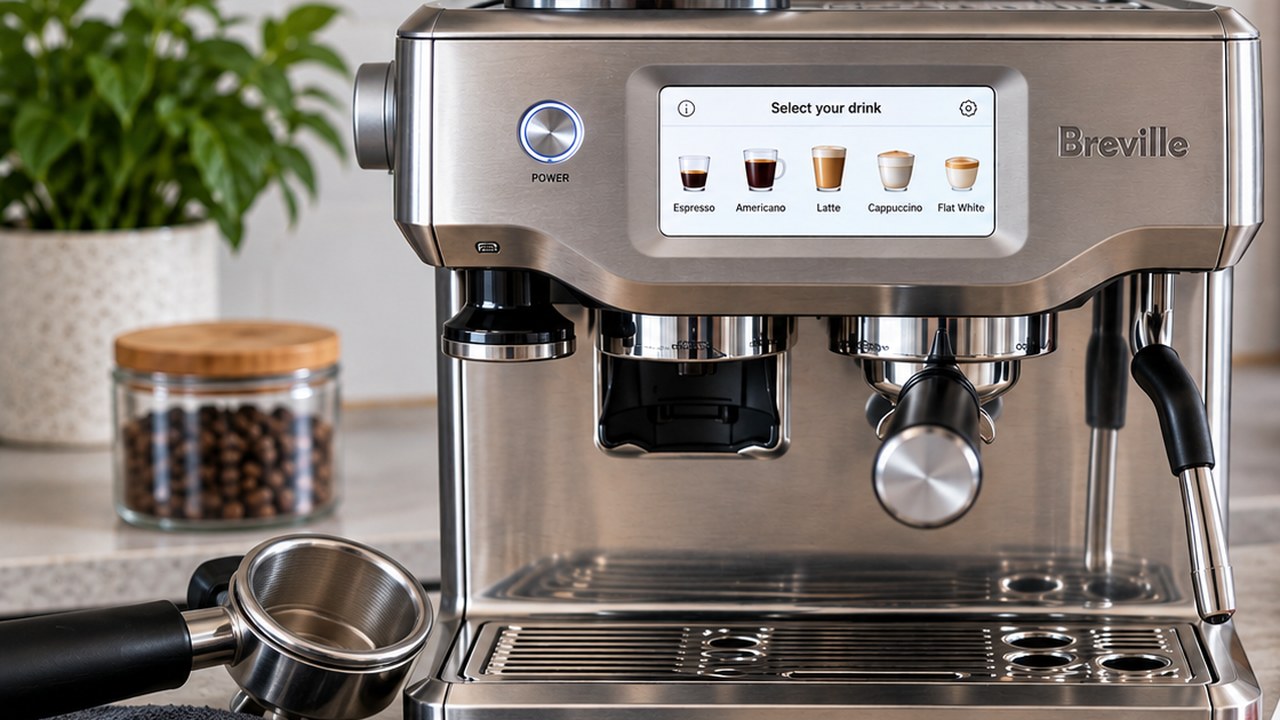
If your Breville Barista Touch BES880 has moved beyond a simple cleaning, grind adjustment, or reset, the next question is whether it can be repaired — and whether repairing it still makes financial sense.
The answer depends heavily on what has failed. Breville officially documents some user-serviceable work, including replacement of the silicone seal around the shower screen. Other failures involving internal wiring, pumps, valves, sensors, control boards, or internal leaks are a different category and are better handled through Breville or a qualified espresso-machine repair service.
This guide is specifically for the Breville Barista Touch BES880. It does not cover the newer Barista Touch Impress BES881, which uses different hardware and should be treated as a separate repair platform.
Breville Barista Touch repair: what can actually be fixed?
| Problem | Typical next step | DIY? |
|---|---|---|
| Worn group-head silicone seal | Replace seal following Breville procedure | Yes, officially documented |
| Damaged shower screen | Replace compatible 54 mm screen | Usually straightforward |
| Damaged portafilter, basket, water tank, or drip tray | Replace external component | Yes |
| Blocked grinder or steam wand | Clean and troubleshoot before repairing | Usually maintenance, not repair |
| Milk sensor / ER05-type fault | Diagnosis may lead to internal sensor or wiring repair | Professional repair preferred |
| Internal water leak | Identify source and service internal component | No |
| Pump or valve failure | Internal diagnosis and replacement | No |
| Grinder motor or electrical failure | Internal service | No |
| Touchscreen or control-board failure | Professional diagnosis | No |
| Machine repeatedly loses power or trips protection | Stop using and have it serviced | No |
Repair or troubleshoot first?
Many symptoms that look like a failed component are still caused by routine problems such as scale buildup, a blocked basket, an incorrectly seated water tank, a jammed grinder chute, or a blocked steam tip.
That is why repair should come after normal troubleshooting rather than replacing it.
If you have not yet isolated the fault, start with our Breville Barista Touch troubleshooting guide. It covers brewing, water-flow, grinder, steam, power, temperature, leak, and touchscreen checks without opening the machine.
Move into repair territory when those normal checks have ruled out cleaning, setup, extraction, and maintenance causes and the evidence points toward a failed physical component.
The BES880 repair Breville actually documents for owners
The clearest example is the silicone seal surrounding the shower screen.
Breville states that this seal wears over time and may need replacement to keep the portafilter sealing correctly against the group head.
A worn seal can become relevant when:
- Water or espresso escapes around the edge of the portafilter during extraction.
- The portafilter no longer feels as secure in the group head.
- Cleaning coffee from the basket rim does not stop the leakage.
- The machine has substantial use and the original seal has never been replaced.
How Breville says to replace the silicone seal
Because Breville includes this procedure in the BES880 instruction manual, it is one repair we are comfortable summarizing as owner-serviceable.
- Switch the Barista Touch off and unplug it from the wall.
- Remove the water tank and drip tray.
- Clean coffee residue from the center of the shower-screen screw.
- Use a flat-head screwdriver to loosen and remove the screw.
- Remove the shower screen and note its original orientation.
- Remove the old silicone seal and install the replacement with the flat side inserted first and the ribbed side facing outward.
- Reinstall the shower screen and screw.
- Tighten until the screw is flush, but do not overtighten it.
- Reinstall the water tank and drip tray before testing the machine.
If leakage continues after the correct seal has been installed and the portafilter and basket rim are clean, the problem may lie elsewhere and further disassembly should not be the automatic next step.
Shower screen and other external BES880 parts
Breville also sells or documents replaceable external components for the BES880 platform, including the 54 mm shower screen and common coffee-contact parts.
External components are usually the simplest repair category because replacing them does not require diagnosing a powered internal system.
Examples include:
- 54 mm portafilter.
- Filter baskets.
- Shower screen.
- Group-head silicone seal.
- Portafilter spring.
- Water tank.
- Drip tray.
- Cleaning accessories.
We are deliberately not turning this repair guide into a complete BES880 parts catalog. Replacement-parts searches have their own buying intent, so compatibility should always be checked by exact model and part number rather than assuming every 54 mm Breville component fits every machine.
If you already know which external component you need to replace, our Breville Barista Touch parts guide covers BES880 seals, screens, baskets, portafilter parts, grinder components, water-system parts, compatibility checks, and production revisions.
ER05, ER06, ER07, and ER08: why sensor errors are different
One of the better-documented independent BES880 repair areas involves the milk-jug sensing system.
Specialist repair suppliers associate errors such as ER05 and related ER07/ER08 faults with the milk sensor assembly, wiring, connections, or alignment around the jug-sensing system.
The important point is that repairing that system involves removing machine panels and accessing internal wiring and sensor components.
That is where we draw the line between an officially documented owner replacement such as the shower-head seal and an internal electronic repair.
If your BES880 displays a persistent sensor error after normal cleaning, jug positioning, restarting, and user-level troubleshooting, record the exact code and contact Breville or an espresso-machine repair technician. The code gives the technician a much better starting point than simply reporting that the frother has stopped working.
Internal water leaks should not be treated like a loose drip tray
Water around an espresso machine can come from something harmless or something that deserves immediate attention.
A full drip tray, incorrectly installed reservoir, spilled refill water, or leaking portafilter seal can often be identified without opening the machine.
Water emerging from underneath the housing when those external sources have been ruled out is different.
The BES880 contains pumps, tubing, valves, heaters, sensors, wiring, and mains-powered electronics. If the evidence points to an internal leak, unplug the machine and do not continue running it simply to see where more water appears.
A technician can pressure-test or inspect the water path without normalizing repeated operation of a leaking electrical appliance.
Pump and valve repairs
A machine with poor water flow does not automatically need a new pump.
Scale, an empty or poorly seated tank, blocked coffee, or an overdue descale can all produce symptoms that resemble pump trouble. Those possibilities belong in troubleshooting and should be eliminated first.
A pump or internal valve becomes more plausible when water supply and external restrictions have been ruled out but the machine still cannot generate normal flow or pressure.
At that point, diagnosis requires access to internal hydraulic and electrical components. We would use a Breville-authorized or experienced espresso-machine repair service rather than replacing parts based only on the symptom.
What if the grinder itself has failed?
First distinguish a blocked coffee path from a mechanical or electrical grinder failure.
A hopper full of oily beans, compacted grounds around the burrs, or a blocked chute can stop coffee from reaching the portafilter even when the grinder motor is still functioning.
Normal burr and chute cleaning should therefore come before repair.
If the grinder does not run, repeatedly stalls after cleaning, produces abnormal mechanical noises, or shows signs of an electrical failure, internal service becomes more appropriate.
Do not keep repeatedly energizing a grinder that is mechanically jammed or making a new grinding, clicking, or burning-type noise in the hope that it will clear itself.
Touchscreen and control-board problems
The touchscreen is one of the BES880’s defining features, but a failed screen can also make otherwise functional hardware difficult or impossible to control.
An occasional freeze should first be treated as troubleshooting: shut the machine down normally, disconnect power briefly, restart it, and determine whether the fault returns.
If part of the touchscreen consistently fails to respond, the machine continually reboots, or the display remains unusable after normal restarting, the problem has moved beyond a simple settings issue.
Touchscreen, control-board, wiring, and power-supply diagnosis involve powered electronics and should be serviced professionally.
Is your Barista Touch still under warranty?
Check this before paying anyone to open the machine.
Breville currently lists a 2-year warranty for the Barista Touch BES880 in the U.S. Breville’s warranty process can include repair, replacement, reimbursement, or replacement of qualifying defective parts, depending on the circumstances and warranty terms.
Breville asks owners to have the model number, batch or serial information, and proof of purchase available when making a claim.
If your machine is still within warranty, contact Breville before paying for third-party internal repair or modifying the machine. A DIY repair that involves internal panels or wiring is particularly difficult to justify when manufacturer coverage may still apply.
What happens when the warranty has expired?
An expired warranty does not mean Breville has no repair path.
Breville’s U.S. warranty information states that customers whose warranty has expired may still purchase replacement parts or have products repaired by an authorized servicer. Breville recommends contacting Consumer Support for information about the appropriate service route.
That is important because Breville does not publish one universal BES880 out-of-warranty repair price that applies to every failure and every location.
A leaking seal, failed sensor, damaged grinder, pump fault, and touchscreen failure are completely different repairs. Treat any website quoting one universal “Barista Touch repair cost” with caution unless it clearly states what labor, parts, shipping, diagnosis, and warranty are included.
How much should you spend repairing a BES880?
There is no single correct dollar threshold because machine age, condition, local labor, shipping, and the failed component all matter.
A better decision process is:
- Confirm that the problem really requires repair rather than cleaning or adjustment.
- Check warranty status.
- Get the actual repair quote, including diagnosis, labor, parts, and shipping.
- Consider the age and overall condition of the grinder, steam system, touchscreen, and water system — not only the failed part.
- Compare the total repair cost with the price and warranty of the machine you would buy instead.
When this article was researched, Breville listed a new Barista Touch BES880 in the U.S. at $999.95. That does not mean every repair below a certain percentage automatically makes sense, but it gives you a current replacement benchmark rather than comparing a repair quote with the machine’s original purchase price from years ago.
Repair the Barista Touch if…
- The machine is still under warranty.
- The problem is a straightforward external component or documented seal replacement.
- The grinder, touchscreen, steam system, and brewing system are otherwise in good condition.
- You receive a clear repair quote with parts and labor identified.
- The repair service provides meaningful warranty coverage on its work.
- You like the BES880 workflow enough that replacing it would not actually be an upgrade for you.
Consider replacing it instead if…
- The machine has multiple unrelated failures rather than one isolated defect.
- There is extensive internal leakage or corrosion.
- The repair quote is high enough that a newer machine with a fresh warranty becomes more attractive.
- The grinder, touchscreen, milk system, and brewing components all show significant age or wear.
- You were already considering changing to a different workflow.
If replacement has become realistic, our Ninja Luxe Café Pro vs Breville Barista Touch comparison shows how the BES880 compares with a current guided alternative rather than assuming you should automatically buy the same machine again.
Where to get a Breville Barista Touch repaired
For U.S. owners, Breville should be the first contact when:
- The BES880 is still under warranty.
- You need confirmation of an authorized repair route.
- You need a genuine replacement component that is not easily identified.
- The problem involves internal electronics, pumps, valves, sensors, or unexplained leakage.
Breville currently provides support through its U.S. product hub, support cases, chat, and telephone support. For out-of-warranty machines, Breville states that authorized servicing may still be available.
If you use an independent espresso-machine technician instead, ask whether they specifically work on Breville/Sage thermocoil or ThermoJet machines and whether they can obtain BES880-compatible components before paying to ship a heavy espresso machine across the country.
Information to collect before requesting repair
A useful repair request is more specific than “my coffee machine is broken.”
Before contacting support, collect:
- Exact model: BES880.
- Serial or batch information from the machine label.
- Proof of purchase if available.
- The exact error code shown on screen.
- Whether the failure affects brewing, grinding, steaming, hot water, or the entire machine.
- Whether the problem is permanent or intermittent.
- What cleaning, descaling, reset, or troubleshooting steps have already been completed.
- A short video of the fault if it involves unusual noises, leaking, or intermittent behavior.
That information can prevent paying for diagnosis only to be asked to repeat basic troubleshooting you have already completed.
Breville Barista Touch repair: final decision
The BES880 is repairable, but “repairable” does not mean every owner should open the machine.
Breville explicitly documents owner replacement of the group-head silicone seal, and replaceable external coffee-contact parts make several wear problems straightforward to solve. Those are very different from faults involving internal leaks, pumps, valves, milk-sensor wiring, grinder electronics, touchscreen hardware, or control boards.
For those internal failures, use the error code and symptoms to identify the likely subsystem, then get a proper repair route or quote rather than purchasing internal parts by guesswork.
Start with troubleshooting, repair an isolated fault when the rest of the BES880 is healthy, and compare the real repair quote with replacement only after you know what has actually failed.