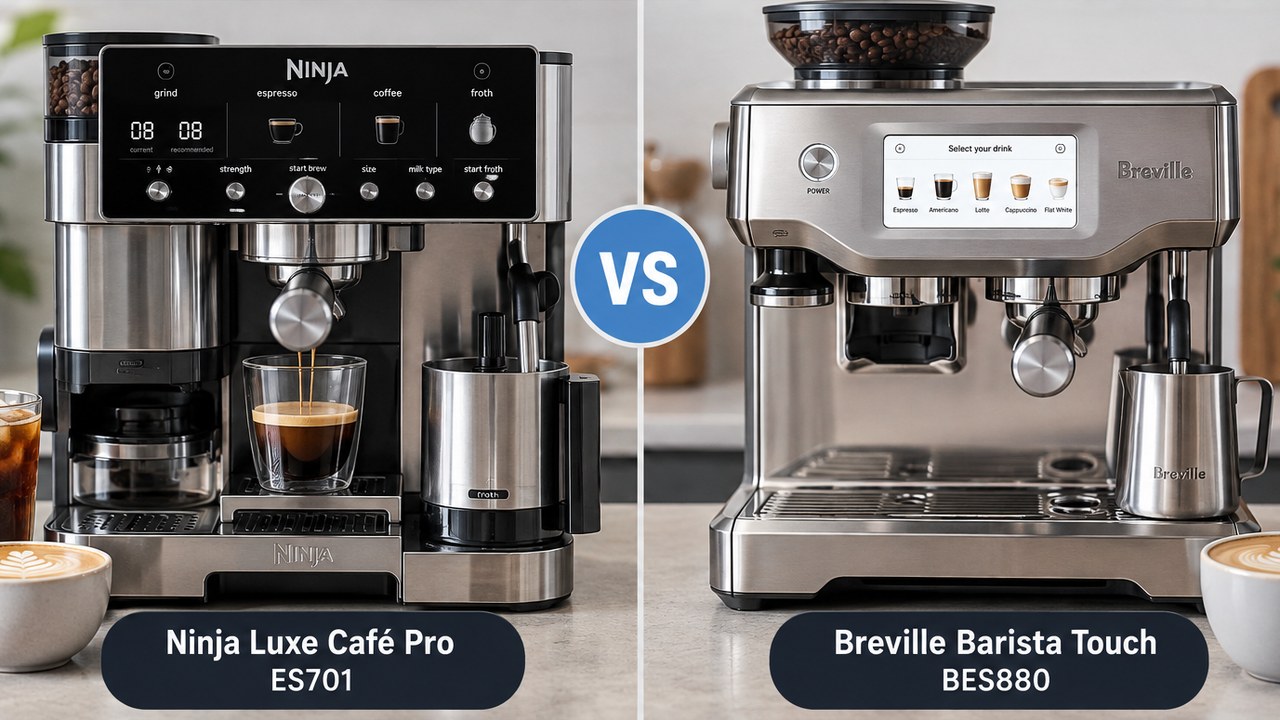
The Ninja Luxe Café Pro ES701 and Breville Barista Touch BES880 solve a similar problem in very different ways: both make home espresso easier without becoming fully automatic bean-to-cup machines.
The Ninja focuses on guidance and versatility. It weighs the dose, recommends grind changes, tamps with an integrated lever, froths milk hands-free, and also makes drip coffee, rapid cold brew, and hot water. The Breville focuses more tightly on espresso drinks, using a touchscreen, fast ThermoJet heating, programmable recipes, and highly adjustable automatic milk texturing.
For most buyers choosing strictly between these two, we think the Ninja Luxe Café Pro offers more value. It currently costs about $250 less in the U.S., automates tamping and dosing more completely, and covers far more drink types. The Barista Touch is the better fit if your priority is an espresso-centered workflow with a polished touchscreen, saved drinks, and more granular milk temperature and texture control.
This comparison is specifically between the Ninja Luxe Café Pro ES701 and Breville Barista Touch BES880. The newer Barista Touch Impress BES881 is a different machine with assisted tamping and should not be treated as interchangeable with the BES880.
Ninja Luxe Café Pro vs Breville Barista Touch: quick verdict
| Category | Winner | Why |
|---|---|---|
| Overall value | Ninja ES701 | Lower current price and more functions |
| Ease of espresso setup | Ninja ES701 | Weight-based dosing, grind guidance, integrated tamping |
| Touchscreen workflow | Breville BES880 | Color touch interface and saved recipes |
| Milk customization | Breville BES880 | 8 texture levels and adjustable temperature |
| Cold drinks | Ninja ES701 | Rapid cold brew, cold-pressed drinks, and cold foam |
| Regular coffee | Ninja ES701 | Dedicated drip-style coffee modes |
| Tamping | Ninja ES701 | Integrated lever instead of manual removable tamper |
| Espresso-focused customization | Breville BES880 | Touch recipes, PID-based brewing, adjustable drink settings |
| Multi-user household | Depends | Ninja for drink variety; Breville for saved personalized espresso drinks |
The biggest difference is not espresso quality
Both machines are capable of making genuinely good espresso. The more useful buying distinction is how much work you want the machine to manage and what else you expect it to make.
The ES701 is essentially a guided coffee station. Ninja tries to remove uncertainty from grinding, dosing, tamping, brewing, and milk preparation while also supporting several non-espresso drink formats.
The Barista Touch is more focused. Its touchscreen walks you through familiar café drinks and lets you customize and save them, but puck preparation remains more traditional: grinding is assisted, while tamping is still manual.
If you want a deeper evaluation of the Ninja by itself rather than another comparison, our Ninja Luxe Café Pro review covers the ES701’s strengths, weaknesses, owner feedback, and value separately.
ES701 vs BES880 specifications
| Feature | Ninja Luxe Café Pro ES701 | Breville Barista Touch BES880 |
|---|---|---|
| Current U.S. manufacturer price when checked | $749.99 | $999.95 |
| Grinder | Integrated conical burr | Integrated hardened-steel conical burr |
| Grind settings | 25 | 30 |
| Built-in scale | Yes | No |
| Grind guidance | Yes, Barista Assist | Adjustable grinder; no equivalent adaptive grind recommendation |
| Tamping | Integrated lever | Manual removable magnetic tamper |
| Portafilter | Removable portafilter system | 54 mm stainless steel |
| Milk | Hands-free Dual Froth System Pro | Hands-free Auto MilQ steam wand |
| Milk settings | 5 froth presets | 8 texture levels plus adjustable temperature |
| Cold foam | Yes | No dedicated cold-foam mode |
| Drip coffee | Yes | No |
| Rapid cold brew | Yes | No dedicated cold-brew mode |
| Independent hot water | Yes | Yes |
| Interface | Buttons/display with guided recommendations | Color touchscreen |
| Saved custom drinks | No equivalent touchscreen profile system | Up to 8 customized coffees |
| Warranty | 1 year limited | 2 years |
| Weight | 31.66 lb | 21.8 lb |
Price: the Ninja has a major advantage
At the time this comparison was researched, SharkNinja listed the ES701 at $749.99, while Breville listed the BES880 at $999.95.
That approximately $250 difference changes the comparison substantially.
The Breville is not simply a more expensive version of the Ninja. You are paying for a different experience: touchscreen operation, customizable saved drinks, a fast ThermoJet heating system, more granular milk control, and Breville’s more established espresso platform.
The Ninja, however, gives you several functions the more expensive Breville does not have, including drip coffee, rapid cold brew, cold foam, weight-based dosing, and integrated lever tamping.
For a buyer without a strong preference for Breville’s interface, that makes the ES701 difficult to beat on feature-per-dollar value.
Grinding and dosing: Ninja does more of the thinking
Both machines include conical burr grinders, but their philosophy is different.
The Barista Touch gives you 30 grind settings and dose control. You choose your grind based on how the espresso is behaving and adjust it as needed.
The ES701 has 25 settings but adds two important systems: weight-based dosing and Barista Assist grind recommendations.
Ninja weighs the grounds rather than relying only on grind time, then uses previous extraction behavior to suggest whether you should change the grind setting.
That makes the Ninja easier for someone who does not yet know what an overly fast or slow extraction means.
The recommendation is still guidance rather than an absolute rule. Beans, roast level, age, humidity, and taste can make a setting that the machine likes different from the one you prefer.
If you already own the Ninja and need the grinder explained in detail, our Ninja Luxe Café Pro grind size guide owns that topic rather than expanding it further here.
Tamping: this is a bigger difference than it sounds
The ES701 has an integrated lever tamper. Grind into the portafilter, pull the lever, and the puck is compressed without taking a separate tamper to the counter.
The BES880 Barista Touch uses a manual removable magnetic tamper.
This is one of the easiest places to accidentally confuse the Barista Touch with the Barista Touch Impress. The BES881 Impress has an assisted tamping system; the BES880 in this comparison does not.
If you enjoy puck preparation, the Breville’s manual tamping is not necessarily a disadvantage. If your priority is repeatability and less mess before work, the Ninja has the more convenient workflow.
Which makes better espresso?
We would not declare a universal espresso-quality winner without controlled side-by-side testing using the same beans, water, dose, and extraction targets.
What we can say from the hardware and independent experience is that both machines can make strong espresso, but they appeal to different users.
The Breville is more explicitly espresso-centered. It uses a 54 mm stainless steel portafilter, an 18 g target dose, low-pressure pre-infusion followed by 9-bar extraction, and PID temperature control. Its workflow encourages you to make and save adjustments yourself.
The Ninja puts more emphasis on getting you into a useful extraction range quickly. Its scale, automated dose calculation, grind guidance, and integrated tamping remove several variables that beginners otherwise have to learn simultaneously.
For an experienced espresso user, we would give the Breville the edge in espresso-focused control. For a beginner trying to achieve repeatable good shots with less trial and error, we would choose the Ninja.
Milk drinks: Breville gives you more control, Ninja gives you more modes
Both machines can texture milk automatically, so neither requires you to master traditional steam-wand technique before making a latte.
The Barista Touch’s Auto MilQ system allows milk temperature adjustment from 104°F to 167°F and provides eight texture levels. That is unusually granular for a hands-free system and makes it easy to save a latte exactly how you prefer it.
The Ninja uses five presets: steamed milk, thin froth, thick froth, extra-thick froth, and cold foam. Its XL jug can also be useful when preparing milk for more than one drink.
Our decision here is simple:
- Choose Breville if controlling hot-milk temperature and texture is more important.
- Choose Ninja if you value automatic cold foam and several easy preset textures.
The Barista Touch touchscreen is genuinely better for saved drinks
One feature the Ninja cannot really duplicate is the BES880’s touchscreen experience.
The Barista Touch includes five pre-programmed café favorites and lets you create, name, and save up to eight customized coffees. Coffee strength, milk temperature, and milk texture can become part of a repeatable recipe rather than something you reselect each morning.
That is particularly useful in a household where one person likes a hotter flat white and someone else wants a foamier latte.
Ninja provides guidance, but it does not revolve around named touchscreen drink profiles. Its strength is helping you prepare many drink formats rather than storing a personalized café menu.
The Ninja wins easily for drip coffee and cold drinks
This is the least ambiguous category in the comparison.
The ES701 is designed as a four-in-one system covering espresso, drip-style coffee, rapid cold brew, and independent hot water. It also supports cold-pressed-style espresso drinks and cold milk foam.
The Barista Touch is primarily an espresso-based drink machine. It can dispense hot water and make café recipes such as lattes and cappuccinos, but it is not designed to replace a drip brewer or provide Ninja’s dedicated cold-coffee modes.
If one person wants espresso while another routinely wants a 12- or 16-ounce regular coffee, that alone can justify choosing the Ninja.
Breville heats up faster
Breville specifies a 3-second ThermoJet heat-up time for the Barista Touch.
That does not mean a complete drink takes three seconds — grinding, puck preparation, extraction, and milk still take time — but it substantially reduces waiting for the machine itself to become ready.
Ninja does not make the same three-second claim for the ES701, so we would give Breville the advantage for documented startup speed rather than inventing an unsupported side-by-side number.
Counter space: the Breville is the lighter machine
The Ninja ES701 is a substantial appliance at 31.66 pounds. SharkNinja lists it at 15.51 inches long, 15 inches wide, and 19.33 inches high.
Breville lists the BES880 at 21.8 pounds, making it roughly 10 pounds lighter. Its current U.S. product documentation lists a notably smaller overall footprint than the Ninja, although Breville has shown slightly different dimension ordering on different versions of its product page.
For that reason, we would measure the actual available counter and cabinet clearance rather than buying based on a single dimensions row.
The Ninja also needs usable space around the bean hopper, rear reservoir area, portafilter, integrated tamper lever, and milk jug. Its physical footprint is part of the price you pay for combining several appliances into one.
Maintenance: neither is a push-button superautomatic
Both machines reduce preparation work, but neither removes the portafilter or cleaning routine.
You still need to knock out used coffee, clean baskets, empty the drip tray, maintain the grinder area, clean milk-contact parts, change water filters where applicable, and perform cleaning and descaling cycles.
The Ninja has more brewing systems to maintain because it covers drip and cold coffee in addition to espresso. It also performs automatic flushing that can consume enough water to make reservoir refills and drip-tray emptying noticeable in heavy use.
The Breville has an automatic steam-wand cleaning function, but manual puck preparation means more direct handling of grounds around the portafilter.
If you already own the BES880 and are dealing with a fault rather than deciding which machine to buy, see our Breville Barista Touch troubleshooting guide for common brewing, water-flow, grinder, steam, power, and touchscreen problems.
Warranty: Breville has the stronger written coverage
SharkNinja lists a one-year limited warranty for the ES701. Breville lists a two-year warranty for the Barista Touch BES880.
That difference matters more on a machine approaching $1,000 than it would on a basic coffee maker.
We would not assume that warranty length automatically proves one machine will last longer, but the Breville gives the buyer an additional year of stated manufacturer coverage.
What real owners say about both machines
The owner ratings are remarkably similar.
When this comparison was researched, Best Buy showed the Ninja ES701 at approximately 4.7 out of 5 from about 500 reviews, with roughly 94% recommending it. The Barista Touch BES880 was also around 4.7 out of 5, but from more than 1,250 reviews, with about 94% recommending it.
Ninja owners most frequently praise ease of use, coffee quality, and overall performance. Recurring criticisms include water usage, drip-tray filling, noise, and isolated reliability problems.
Breville owners similarly praise coffee quality, ease of use, the touchscreen, and overall performance. The higher price and some noise complaints appear among the negative themes.
The Breville’s much larger review sample also reflects the fact that the BES880 has been on the market considerably longer than the newer Ninja platform. We would therefore avoid reading the matching 4.7-star averages as evidence that long-term reliability is necessarily identical.
Choose the Ninja Luxe Café Pro if…
- You want the machine to recommend grind adjustments.
- You want grounds dosed by weight using a built-in scale.
- You want an integrated tamping lever.
- You make both espresso and regular coffee.
- You frequently make iced or cold coffee drinks.
- Cold milk foam matters to you.
- You want to spend around $750 rather than around $1,000.
- You value guidance more than touchscreen customization.
Choose the Breville Barista Touch if…
- Your drinks are primarily espresso, lattes, cappuccinos, and similar café drinks.
- You want a touchscreen rather than button-driven guidance.
- You want to save named customized coffee recipes.
- Fine control over milk temperature and texture matters more than cold foam.
- You do not mind tamping manually.
- You prefer a more established espresso-machine platform.
- A two-year manufacturer warranty matters to you.
- The roughly $250 higher current list price fits your budget.
What if the Ninja Pro is more machine than you need?
If you like the Ninja approach but do not need every ES701 upgrade, do not automatically move to the Breville.
Our Ninja Luxe Café Pro vs Premier comparison explains whether the cheaper ES601 gives you enough of the same core system without paying for the Pro’s additional features.
Ninja Luxe Café Pro vs Breville Barista Touch: final verdict
We would choose the Ninja Luxe Café Pro ES701 for most households.
At current U.S. manufacturer pricing, it costs roughly $250 less yet adds a built-in scale, adaptive grind guidance, integrated tamping, drip coffee, rapid cold brew, and cold foam. Those are meaningful workflow differences rather than decorative extras.
The Breville Barista Touch BES880 still has an important audience. Its touchscreen is significantly more polished for personalized café drinks, its automatic milk system gives finer temperature and texture control, it heats extremely quickly, and its two-year warranty is stronger on paper.
So the decision comes down to what you want automated.
Choose the Ninja if you want the machine to help manage the coffee-making process itself. Weight-based dosing, grind recommendations, integrated tamping, and broader brew modes reduce both decision-making and the need for separate appliances.
Choose the Breville if you want to personalize espresso-based drinks through a touchscreen while retaining more of the traditional puck-preparation process.
And if a listing says Barista Touch Impress BES881, stop and recheck the comparison: that is not the BES880 Barista Touch evaluated on this page.